Today's
EarthStation1.com 15% (Or More!) Off Commemorative Memorial Title:
Labor Union Films Collection DVD, Video Download, USB Flash Drive
Today, September 7, 2026
First Monday In September: September 7,
2026: Labor Day (United States): -- Do you get weekends off work?
Lunch breaks? Paid vacation? An eight-hour workday? Social
security? If you said "yes" to any of these questions,
you can thank labor unions and the U.S. labor movement for it.
Years of hard-fought battles (and the ensuing legislation they
inspired) resulted in many of the most basic benefits we enjoy at
our jobs today. On the first Monday in September, Summer's final
fling arrives as we take the day off to celebrate Labor Day and
reflect on the American worker's contributions to our country.
While Labor Day roughly marks the end of the meteorological Summer
season (June 1 - August 31), the astronomical Summer season (June
21 - September 23) will continue on for about a few more weeks.
School's starting too, and so for all of this, there's a sense
that summer vacation is over. Time Marches On! There is much
disagreement over how the holiday began. One version is set in
September 1882 with the Knights of Labor, the largest and one of
the most important American labor organizations at the time. The
Knights in New York City held a public parade featuring various
labor organizations on September 5 - with the aid of the fledgling
Central Labor Union (CLU) of New York. Subsequently, CLU Secretary
Matthew Maguire proposed that a national Labor Day holiday be held
on the first Monday of each September to mark this successful
public demonstration. In another version, Labor Day in September
was proposed by Peter J. McGuire, a vice president of the American
Federation of Labor. In spring 1882, McGuire reportedly proposed a
"general holiday for the laboring classes" to the CLU,
which would begin with a street parade of organized labor
solidarity and end with a picnic fundraiser for local unions.
McGuire suggested the first Monday in September as an ideal date
for Labor Day because the weather is great at that time of year,
and it falls between July 4th and Thanksgiving. Oregon became the
first U.S. state to make it an official public holiday. 29 other
states had joined by the time the federal government declared it a
federal holiday in 1894. On Sale Until Midnight Tonight PT!
https://store.earthstation1.com/labor-union-films-dvd.html
Today's
EarthStation1.com 15% (Or More!) Off Commemorative Memorial Title:
TV Commercials: The Cable Age Classics III DVD, Download, USB
Drive
Today, September 7, 2026
First Monday In September: September 7,
2026: The West Indian Day Parade (The West Indian Day Parade
Carnival, The Labor Day Parade, J'Ouvert, Jour Ouvert): -- West
Indian culture is colorful and multifaceted. The West Indies
includes an extraordinary range of people and places, but to
simplify things a bit, it's the name for a region of the Caribbean
Sea that includes countries comprising the Greater Antilles, the
Lesser Antilles and the Lucayan Archipelago. But what do we mean
by "West Indian"? It's good to know, not just for
educational purposes, but also in order to understand this
celebration, which takes place each Labor Day in Crown Heights,
Brooklyn, New York City! It is organized by the West Indian
American Day Carnival Association (WIADCA). The main event is the
West Indian Day Parade (also known as simply the Labor Day
Parade), which attracts between one and three million
participants. The parade begins at 6 AM, and because it occurs at
day break, the parade is also known as J'Ouvert, a contraction of
the French word Jour Ouvert, meaning "Day Break", a term
borrowed from the similar traditional festival of the unofficial
start of Carnival, held the Monday before Ash Wednesday. The
spectators and participators watch and follow the parade on its
route along Eastern Parkway. Some of the Caribbean islands
represented in the parade include Trinidad and Tobago, Haiti,
Barbados, Dominica, Saint Lucia, Jamaica, Saint Vincent and
Grenada, along with some Afro-Panamanians. mainland Caribbean
countries such as Guyana, Suriname, and Belize also participate as
well. So, let's party! On Sale Until Midnight Tonight PT!
https://store.earthstation1.com/tv-commercials-the-cable-age-classics-iii-dvd.html
Today's
EarthStation1.com 15% (Or More!) Off Commemorative Memorial Title:
In Heaven There Is No Beer Polka Culture USA MP4 Video Download
DVD
Today, September 7, 2026
September 7: National Beer Lover's Day:
-- An annual celebration of the grains, hops and brewing methods
across many eras. Beer and the process of brewing beer may predate
known history. As varied as the methods, grains, and flavors, beer
continues to change and evolve. Virginia colonists brewed beer.
William Penn included a place for brewing beer within the
Pennsylvania colony. It can still be visited at Pennsbury Manor
today. The first President of the United States recorded a recipe
for brewing beer in his notes. Samuel Adams holds a place in both
beer and tea history in this country. There were a few beer lovers
and patriots among the nation's founders. The United States also
derives its rich brewing history from beer-loving German
immigrants during the mid-1800s. Some of those family names are as
familiar today as they were a hundred years ago. While some names
have faded into the past, smaller batch brewers continue to
experiment with old and new recipes. The crafting of beer carries
deep traditions, often requiring years of training and experience
in the trade. Depending on the brewery, the path to brewmaster may
take years to develop the skill and expertise. Eventually, a
brewmaster gains the knowledge necessary to produce a quality beer
every time. One particular requirement is a passion for the craft.
The brewer will master lagers, ales, malts, and stouts. They may
even specialize. However, their ability to ferment the perfect
beer under each condition and bring out the flavor of the grain
and yeast will be key. Managing temperature and timing for an IPA
or studying grains all go into their education. Each process
varies, and a brewmaster knows this! On Sale Until Midnight
Tonight PT!
https://store.earthstation1.com/in-heaven-there-is-no-beer-polka-culture-usa-mp4-video-download-dv4.html
Today's
EarthStation1.com 15% (Or More!) Off Commemorative Memorial Title:
The Goon Show British Radio Comedy Series MP3 DVD, Download, USB
Drive
Today, September 7, 2026
September 7: National Salami Day: -- A
delicious annual recognizion of a cured meat many people enjoy
every day. Salami are cured, fermented, and air-dried sausages
that find their way to our delis and butcher shops in delicious
variety. Most commonly made with pork, makers use other meats and
blends when preparing salami. For example, delis may offer a lamb,
duck, or a beef and pork blend. The ground sausage is blended with
seasonings and salt air-cured in either a pork or beef casing.
Methods and recipes vary by region and country. Even aging time
varies. However, makers typically age salami between 30 to 90 days
or longer. While salami's beginnings are uncertain, the Romans may
have introduced methods used today. In days before refrigeration,
Salamis were historically popular among Southern European
peasants. The sausage keeps well once cut when stored at room
temperatures for up to 30 to 40 days. Two salamis that might be
familiar to you are Genoa and Hard Salami. Genoa salami ages with
red wine, peppercorns, and garlic. This softer salami offers a
fermented flavor. In contrast, Hard Salami not only falls into the
cured category but makers also dry and smoke the meat. The
resulting salami slices easily. To obervce National Salami Day:
Enjoy salami in a variety of ways! Don't just stop at a sandwich.
The flavor pairs well with a variety of cheeses and pasta sauces.
In a cold pasta dish, salami becomes the star. Don't forget, Italy
gave us this Italian original, even if it's made worldwide! Dice
up salami and add it to a salad. Whatever bounty harvested from
your garden will benefit from the flavor of salami. Just don't add
any additional salt. Most of the seasoning will come from the
salami. Get yourself a few slices of salami and use
#NationalSalamiDay to post on social media! The Salami
Appreciation Society in Henrico, Virginia created National Salami
Day in 2006. On Sale Until Midnight Tonight PT!
https://store.earthstation1.com/the-goon-show-otr-mp3-dvd-spike-milligan-peter-sellers-secomb3.html
Today's
EarthStation1.com 15% (Or More!) Off Commemorative Memorial Title:
TV Commercials: The Cable Age Classics III DVD, Download, USB
Drive
Today, September 7, 2026
September 7: Buy A Book Day: -- This day
is celebrated to raise awareness about the dying book-buying and
book-reading culture. Did you know that the U.S. adult population
that read books has declined by 7% over the past decade? Yes,
buying books and reading them have been a declining habit among
Millennials and Gen-Zs. This is exactly what Buy A Book Day aims
to remedy. In today's digital age where T.V., movies, and the
internet have taken over our lives, the art of book reading and
the very act of buying it is declining dramatically. Although T.V.
series and movies are interesting, reading books is a whole
different kind of experience. Most people think that books are
boring and at no level a match to modern-day series and superhero
movies. But in reality, there are millions of books out there that
are just as well-written, thought-provoking, and can take you to a
whole new world. This is what most people fail to understand.
However, it is sad how the old-fashioned art of reading a book is
slowly fading away just because of a misconception. Books are the
ocean of knowledge - the knowledge that has been passed on by our
ancestors to us. We used these books to discover new knowledge
that we then pass on to the future generation. On Buy a Book Day,
people visit their local book stores to purchase a book or two.
Those who cannot go out to celebrate the day can buy a book
online! Books have transformed many lives from the earliest of
centuries until now. There is no doubt that they will continue to
do so in the future. We know, we know, some of you might still
argue that you are carrying multiple books around at the same time
- thanks to kindle. Good for you, but do you know what can make it
even better? Yes, you guessed right, buying a book made of paper!
So, this Buy A Book Day, buy a book! On Sale Until Midnight
Tonight PT!
https://store.earthstation1.com/tv-commercials-the-cable-age-classics-iii-dvd.html
Today's
EarthStation1.com 15% (Or More!) Off Commemorative Memorial Title:
It Was Twenty Years Ago Today: 1967 & Sgt. Pepper DVD MP4 USB
Drive
Today, September 7, 2026
September 7: National Feel The Love Day:
-- It doesn't matter what kind of love you are celebrating- it
could be your family, friends, pets, or romantic partner. National
Feel the Love Day is about spreading the joys of love as wide as
you can. The day is a reminder of how all kinds of love make our
lives richer. Love makes us happy, secure, and feel understood.
This is the day to count your blessings and cherish the people who
bring you so much joy. Nobody knows when or who came up with
National Feel the Love Day but it sure is a noble concept! We all
remember our first brush with love, especially of the romantic
variety. It is usually experienced early in life and may not last
for very long. Nonetheless, we remember the person and the feeling
of joy it brought. Love, especially romantic love, can work as an
elixir. It can rejuvenate our senses, give us a new lease on life,
and inspire us to be better people. Romantic love can be richly
rewarding too, in the sense that it teaches us to be empathetic
and considerate of other people's needs. Love is also the greatest
muse to artists. Painters, singers, writers, and poets have been
inspired by this all-encompassing feeling. They have made timeless
creations on romantic love but filial love, platonic love, love
for nature, and love for God haven't been left behind either.
Almost all creative expressions have been inspired by some form of
love. It is only natural to want to talk about the overpowering
feeling of love in a creative manner. Artists in love have often
created the best and the most classic creative works. We have so
much we owe to love. Added to that is love's positive impact on
our physical and emotional well-being. Love or the feeling of
comfort can help alleviate our self-esteem, make us feel safe, and
do wonders for our physical health. The feeling of love is known
to keep our hearts healthy, boost our immune system, and even
regulate blood pressure! On Sale Until Midnight Tonight PT!
https://store.earthstation1.com/it-was-20-years-ago-today-1967-and-sgt-pepp201967.html
Today's
EarthStation1.com 15% (Or More!) Off Commemorative Memorial Title:
WWII Films: Combat Medicine And Post War Plans DVD, MP4, USB Drive
Today, September 7, 2026
September 7: National Grateful Patient
Day: -- The best day to show our healthcare workers the
appreciation they deserve. The day is also focused on the families
and caregivers of anyone receiving life-giving medical care and,
additionally, the courageous patients who are grateful to be
alive. Healthcare professionals have been there as long as
medicine has, and we can never truly thank them enough. Healthcare
workers go above and beyond for our sake, and although we often
overlook it, they are one of the most essential parts of our
community at large. There really isn't a lot we can say or do to
reward the saved lives, care, and treatments they give us,
however, a day like this gives us an opening to at least try.
Life-giving care especially impacts the caregivers and patients in
an irreplaceable way. The Grateful Patient Project is a non-profit
organization that was founded by former NFL kicker and Man of the
Year Rolf Benirschke, in 2017. It provides a platform for patients
to share their stories of gratitude for the healthcare providers,
medicines, procedures, and institutions that supported them
through illness and changed their lives. Benirschke was in his
third season with the San Diego Chargers in 1978 when he collapsed
from ulcerative colitis. He required two emergency surgeries
within six days and spent almost six weeks in the intensive care
unit fighting for his life. He survived, returned to the NFL on
September 7, 1980, to play seven more seasons with the San Diego
Chargers, and became the first NFL player ever to wear an ostomy
appliance. Benirschke came through the ordeal committed to
spending his life advocating on behalf of patients and was
inspired to create the organization as an expression of gratitude
to those who supported him through years of medical challenges.
National Grateful Patient Day on September 7 celebrates the strong
patients that overcome seemingly impossible challenges and the
medical workers that are always willing to render a helping hand.
On Sale Until Midnight Tonight PT!
https://store.earthstation1.com/wwii-films-medicine-the-americas-and-post-war-plans-dvd.html
Today's
EarthStation1.com 15% (Or More!) Off Commemorative Memorial Title:
TV Commercials: The Classics Vol. 8 DVD, MP4 Download, USB Flash
Drive
Today, September 7, 2026
September 7: National Neither Snow Nor
Rain Day: -- A special day for us to say a little thank you to our
postal service workers. They have been of service to us for
decades, and through those years, have been steadfast in
delivering our precious parcels. The seemingly strange name for
the day comes from the unofficial motto of the United States
Postal service, "Neither snow nor rain nor heat nor gloom of
night stays these couriers from the swift completion of their
appointed rounds." U.S. Postal service workers are one of the
most dedicated and loyal service teams that exist, and that
impression comes from their willpower to make sure packages are
sent out and delivered with safe hands, and regardless of any
obstacles. National Neither Snow Nor Rain Day is certainly a
mouthful and a weirdly crafted name, but its history begins at the
unofficial creed of the United States Postal Service, "Neither
snow nor rain nor heat nor gloom of night stays these couriers
from the swift completion of their appointed rounds." The
phrase's association with the U.S. Mail originated with its
inscription on New York City's General Post Office Building, which
opened in 1914. It was derived from a passage in George Herbert
Palmer's translation of Herodotus' Histories, referring to the
courier service of the ancient Persian Empire. The day is observed
on September 7, because that was the day New York City opened its
main post office, the James A. Farley building, in 1914. The
building is located in Manhattan, New York, and formerly serves as
the city's main United States Postal Service (USPS) branch. It was
known as the Pennsylvania Terminal until 1918 when it was renamed
the General Post Office Building. The building was made a New York
City designated landmark in 1966 and was added to the National
Register of Historic Places in 1973. It was officially renamed in
1982 after James Farley, the 53rd Postmaster General. Postal
workers and post offices have an even longer history in the United
States. Benjamin Franklin became the first Postmaster General in
1775. In 1847 the first postage stamps were issued, and in 1863,
during the Civil War, free city delivery began. On Sale Until
Midnight Tonight PT!
https://store.earthstation1.com/tv-commercials-the-classics-vol-8-dv8.html
Today's
EarthStation1.com 15% (Or More!) Off Commemorative Memorial Title:
America: The Second Century Documentary Series DVD, Download, USB
Today, September 7, 2026
September 7: International Day Of Clean
Air: -- Get ready to breathe easier today -- it's a time to
recognize the amount of work that must be done to reduce the
effects of smog, smoke, airborne chemicals like excessive CO2, and
other forms of harmful air pollution. It's estimated that about
seven million people worldwide die from diseases related to
unclean air each year. And according to U.N. Secretary General
Antonio Guterres, nine out of ten people regularly breathe
polluted air. In a document compiled and presented at the U.N.'s
74th General Assembly and adopted on December 19, 2019, the
following text addresses clean air, which is only a tiny part of
the whole resolution. "_[C]lean air is important for the
health and day-to-day lives of people _ [and] air pollution is the
single greatest environmental risk to human health and one of the
main avoidable causes of death and disease globally." The
resolution also stresses the importance of across-borders
cooperation, since air pollution does not respect political
boundaries, and it emphasizes that green solutions like electric
and hybrid cars are becoming more and more affordable. World
leaders have enthusiastically recognized the day and its meaning.
Moon Jae-in, President of the Republic of Korea, was quoted in
September of 2020 as saying, "I am very pleased to celebrate
the first International Day of Clean Air for blue skies, which was
adopted at the UN General Assembly last year. I hope this event
[will] help enhance global public awareness of _ transboundary air
pollution and provides [sic] an important milestone in the global
efforts to harness solution-based actions for cleaner air."
According to the Geneva Environment Network, poor air quality has
implications for a wide range of human rights, including the
rights to life, health, water, food, housing and an adequate
standard of living. Air pollution also clearly violates the right
to a healthy and sustainable environment. However, air pollution
is also a preventable problem. The benefits of fulfilling the
right to breathe clean air for all humanity are incalculable!
Science shows there are numerous health and psychological benefits
to breathing clean, fresh air. It helps clear our lungs, gives us
more energy and mental focus, lowers our blood pressure and heart
rate, helps us heal faster and even can improve our digestions.
The United Nations recognition of the difference in air quality
and the intention to do more to purify the air we breathe is
important both symbolically and in a practical sense. Together, on
the International Day of Clean Air and beyond, we can all take
part in that action. On Sale Until Midnight Tonight PT!
https://store.earthstation1.com/america-the-second-century-us-2nd-100-years-history-621006.html
Today's
EarthStation1.com 15% (Or More!) Off Commemorative Memorial Title:
Jesse James & The James-Younger Gang DVD MP4 Download USB
Flash Drive
Today, September 7, 2026
September 7: The Defeat of Jesse James
Days Celebration: -- September 7, 1876: The American Frontier (The
American West, The Wild West, The Old West): Crime: Organized
Crime: Outlaw Gangs Of The American Old West: Crime Families: The
James-Younger Gang: -- In Northfield, Minnesota, Jesse James and
the James-Younger Gang attempt to rob the town's bank. Local
citizens, recognizing what was happening, armed themselves and
resisted the robbers and successfully thwarted the theft. The gang
killed the bank's cashier, Joseph Lee Heywood and a Swedish
immigrant, Nicholas Gustafson. A couple of members of the gang
were killed in the street, while Cole, Bob and Jim Younger were
cornered near Madelia, Minnesota. Jesse and Frank James escaped
west into the Dakotas, while the remaining gang members were
killed or taken into custody. Considering the James Gang as
related to postwar insurgency, the raid has sometimes been called
the last major event of the American Civil War. Two of
Northfield's slogans are "Jesse James Slipped Here",
based on the raid's failure, along with "Get your guns boys,
they're robbing the bank!". The events have become the basis
of an annual outdoor heritage festival called The Defeat of Jesse
James Days. It is held the weekend after Labor Day and is among
the largest outdoor celebrations in Minnesota. Thousands of
visitors witness reenactments of the robbery, which is staged on
Division street, outside of the First National Bank of Northfield.
Other activities during the festival include: a championship
rodeo, carnival, car show, and parade, as well as arts and crafts
expositions, and musical performances. Many food stations are set
up in Bridge Square, and during the evenings live music is played
in a "beer tent" on Water Street. A horseshoe hunt takes
place the week prior to the celebration; an antique horseshoe is
hidden somewhere within the city on public grounds and the finder
claims that year's cash purse. On Sale Until Midnight Tonight PT!
https://store.earthstation1.com/jesse-james-amp-the-jamesyounger-gang-dvd-mp4-download-usb-flash-driv4.html
Today's
EarthStation1.com 15% (Or More!) Off Commemorative Memorial Title:
Pirates 12 Part Documentary Series MP4 Video Download DVD
Today, September 7, 2026
September 7, 1695: Crime: Organized
Crime: Piracy: The Golden Age Of Piracy (1650s-1730s): The Capture
Of The Grand Mughal Fleet: -- The first worldwide manhunt in
recorded history results when Henry Every, infamous English pirate
dubbed The Arch Pirate and The King Of Pirates by contemporaries,
perpetrates one of the most profitable pirate raids in history
with the capture of the treasure-laden ships Ganj-i-Sawai and its
escort, Fateh Muhammed, part of a 25-ship convoy of Grand Mughal
vessels making the annual pilgrimage to Mecca. This caused
considerable damage to England's fragile relations with the
Mughals, and a combined bounty of 1,000 PS - an immense sum at the
time - was offered by the Privy Council and the East India Company
for his capture. Joining forces with several pirate vessels, Every
found himself in command of a small pirate squadron, and they were
able to capture up to 600K PS in precious metals and jewels,
equivalent to around 97.1M PS 2023. Although a number of his crew
were subsequently arrested, Every himself eluded capture,
vanishing from all records in 1696; his whereabouts and activities
after this period are unknown. Unconfirmed accounts state he may
have changed his name and retired, quietly living out the rest of
his life in either Britain or on an unidentified tropical island,
while alternative accounts consider Every may have squandered his
riches. He is considered to have died sometime between 1699 and
1714; his treasure has never been recovered. Henry Every, known as
Long Ben to his crewmen and associates, infamous for being one of
very few major pirate captains to escape with his loot without
being arrested or killed in battle, operated in the Atlantic and
Indian oceans in the mid-1690s, sometimes erroneously named Jack
Avery or John Avery, and who probably used several aliases
throughout his career, including Benjamin Bridgeman (b. c.1656)
disappears without a trace. Although Avery's career as a pirate
lasted only two years, his exploits captured the public's
imagination, inspired others to take up piracy, and spawned works
of literature. On Sale Until Midnight Tonight PT!
https://store.earthstation1.com/pirates-12-part-documentary-series-mp4-video-download-124.html
Today's
EarthStation1.com 15% (Or More!) Off Commemorative Memorial Title:
Combat At Sea Documentary Series + 2 Bonuses MP4 Video Download
DVDs
Today, September 7, 2026
September 7, 1776: Naval Firsts: The Age
Of Enlightenment (The Enlightenment, The Age Of Reason): The Age
Of Revolution: The Atlantic Revolutions: The American
Enlightenment: The American Revolution: The American Revolutionary
War: The Naval History Of The United States: Submarines: The
History Of Submarines: The Turtle (Submersible) (The American
Turtle): The Turtle Submersible's Attack On HMS Eagle: --
According to American colonial reports, Ezra Lee makes the world's
first submarine attack with a documented record of use in combat
in the Turtle, also called American Turtle, history's first
underwater vessel, attempting to attach a time bomb to the hull of
British Admiral Richard Howe's flagship HMS Eagle in New York
Harbor. Ezra Lee (August 1749 - October 29, 1821) was born in
Lyme, Connecticut. On January 1, 1776 he enlisted in the 10th
Continental Regiment, which was raised in Connecticut, as a
sergeant. In August 1776 he was selected by brother-in-law
Brigadier General Samuel Holden Parsons, as one of several
volunteers to learn to operate the Turtle. Turtle was built in
1775 by American David Bushnell as a means of attaching explosive
charges to ships in a harbor, for use against Royal Navy vessels
occupying North American harbors during the American Revolutionary
War. Connecticut Governor Jonathan Trumbull recommended the
invention to George Washington, who provided funds and support for
the development and testing of the machine. When General George
Washington authorized the attack on HMS Eagle, Lee was chosen to
operate the "infernal machine". Sergeant Lee piloted the
Turtle up to the Eagle, which was moored off what is today called
Governors Island, due south of Manhattan. A common misconception
was that Lee failed because he could not manage to bore through
the copper-sheeted hull. In practice, it has been shown that the
thin copper would not have presented any problem to the drill, and
that he likely struck a metal rudder support. A more likely
scenario is that Lee's unfamiliarity with the vessel made him
unable to keep the Turtle stable enough to work the drill against
the Eagle's hull. When he attempted another spot in the hull, he
was unable to stay beneath the ship, and eventually abandoned the
attempt. Governors Island is off the southern vertex of Manhattan,
this is the place where the Hudson River and the East River merge.
The currents at this point would be strong and complex. The Turtle
would only be able to attack ship moored here during the short
period of time when the incoming tide balanced the river currents.
It is possible that during the attack the tide turned and Lee was
unable to compensate. He released the keg of gunpowder when
British in row boats attempted to pursue him. The British,
suspecting some trick, gave up their pursuit. Lee landed safely
after remaining several hours in the water, and received the
congratulations of General Israel Putnam and General George
Washington, who afterwards employed him on secret service/special
forces. Though no British records of this attack exist, the Royal
Navy Submarine Museum has a replica of Turtle on display, as does
the Connecticut River Museum, the U.S. Navy's Submarine Force
Library and Museum and the Oceanographic Museum (Monaco). Lee made
an attempt a short time afterward with Turtle to destroy a British
frigate that lay opposite the village of Bloomingdale, but was
discovered and compelled to abandon the enterprise. The submarine
was soon afterward sunk by the British as it sat on its tender
vessel, in Fort Lee, New Jersey. Years later in a letter to Thomas
Jefferson, Bushnell reported he had salvaged the Turtle; its final
fate is unknown. During the Revolution, Lee participated in the
battles of Trenton, Brandywine, and Monmouth. He had his sword
handle shot off and received many bullet holes in his coat at
Brandywine. He was discharged from the army in June 1782. Lee is
buried in the Duck River Cemetery in modern-day Old Lyme,
Connecticut. Lee's headstone says "He was a Revolutionary
Officer, and esteemed by Washington." His 1821 obituary
mentioned that, "This soldier is the only man who fought the
enemy upon land, upon water, and under the water." A
submersible is a small watercraft designed to operate underwater,
a term often used to differentiate from other underwater vessels
known as submarines, in that a submarine is a fully autonomous
craft, capable of renewing its own power and breathing air,
whereas a submersible is usually supported by a surface vessel,
platform, shore team or sometimes a larger submarine. In common
usage by the general public, however, the word submarine may be
used to describe a craft that is by the technical definition
actually a submersible. While Turtle was the first underwater
vessel, and the first submersible, the first full-fledged
practical submarine was the Nautilus, built by another American,
Robert Fulton, engineer and inventor who is widely credited with
developing a commercially successful steamboat (Cornelis Drebbel's
vessel of 1620, built in 1620 while working for the English Royal
Navy, was the first navigable submarine, accounts of the craft
contained significant elements of exaggeration and was at best a
semi-submersible, powered down the Thames during tests only by the
force of the current). In 1864, late in the American Civil War,
the Confederate navy's H. L. Hunley became the first military
submarine to sink an enemy vessel, the Union sloop-of-war USS
Housatonic. Submarines were not put into service for any
widespread or routine use by navies until the early 1900s, when
the Holland Type VI submarine, which used internal combustion
engine power on the surface and electric battery power underwater,
was launched on May 17, 1897 at Navy Lt. Lewis Nixon's Crescent
Shipyard in Elizabeth, New Jersey. Holland VI was purchased by the
United States Navy on April 11, 1900, becoming the Navy's first
commissioned submarine, christened USS Holland. On Sale Until
Midnight Tonight PT!
https://store.earthstation1.com/combat-at-sea-dvd-set-all-12-naval-warfare-tv-shows-6-di126.html
Today's
EarthStation1.com 15% (Or More!) Off Commemorative Memorial Title:
Napoleon Bonaparte Documentaries Collection MP4 Video Download DVD
Today, September 7, 2026
September 7, 1812: The Age Of
Enlightenment (The Enlightenment, The Age Of Reason): The Age Of
Revolution: The Atlantic Revolutions: The French Revolution: The
French Revolutionary And Napoleonic Wars (The Great French War)
(The French Revolutionary Wars, The Napoleonic Wars): The
Napoleonic Wars: The French Invasion Of Russia (The Russian
Campaign, The Patriotic War Of 1812): The Battle Of Borodino: --
The bloodiest battle of the Napoleonic Wars is fought near the
village of Borodino, Russia near Moscow. The Battle Of Borodino
(Russian: Borodinskoye Srazheniye; French: Bataille de la Moskova
(Battle Of The Moskova River) involved around 250,000 troops and
left at least 70,000 casualties, making Borodino the deadliest day
of the Napoleonic Wars. Napoleon's Grande Armee launched an attack
against the Russian army, driving it back from its initial
positions but failing to gain a decisive victory. Both armies were
exhausted after the battle and the Russians withdrew from the
field the following day. Borodino represented the last Russian
effort at stopping the French advance on Moscow, which fell a week
later. However, the French had no clear way of forcing Tsar
Alexander to capitulate because the Russian army was not
decisively defeated, resulting in the ultimate defeat of the
French invasion following the retreat from Moscow in October.
After a series of Russian retreats at the beginning of the
campaign, the nobility grew alarmed about the advancing French
troops and forced the Tsar to dismiss the army's commander,
Barclay de Tolly. Mikhail Kutuzov was appointed as his
replacement. In a final attempt to save Moscow, the Russians made
a stand near the village of Borodino, west of the town of
Mozhaysk. They fortified their positions and waited for the French
to attack. The Russian right wing occupied ideal defensive
terrain, so the French tried to press the Russian left for much of
the battle. The highlight of the fighting became the bloody
struggle for the large Raevsky redoubt near the village of
Borodino. The French managed to capture this redoubt late into the
day, gradually forcing the rest of the Russian army to pull back
as well. The Russians suffered terrible casualties during the
fighting, losing over a third of their army. French losses were
also heavy, exacerbating the logistical difficulties that Napoleon
encountered in the campaign. The exhaustion of the French forces,
and the lack of information on the condition of the Russian army,
persuaded Napoleon to remain on the battlefield with his army
instead of ordering the kind of vigorous pursuit reminiscent of
previous campaigns. Napoleon's Imperial Guard, the only unit on
the battlefield that saw no fighting, was available to swing into
action at a moment's notice. In refusing to commit the Guard, some
historians believe, he lost his one chance to destroy the Russian
army and to win the campaign. The capture of Moscow proved a
pyrrhic victory, since the Russians had no intention of
negotiating with Napoleon for peace. The French evacuated Russia's
spiritual capital in October and conducted a difficult retreat
that lasted until December, by which point the remainder of the
Grande Armee had largely unraveled. Historical reports of the
battle differed significantly depending on whether they originated
from supporters of the French or Russian side. Factional fighting
among senior officers within each army also led to conflicting
accounts and disagreements over the roles of particular officers.
Pyotr Ilyich Tchaikovsky composed his 1812 Overture to commemorate
the battle. The overture debuted in Moscow on August 20, 1882,
conducted by Ippolit Al'tani under a tent near the then-unfinished
Cathedral Of Christ The Saviour, which also memorialized the 1812
defence of Russia. The overture was conducted by Tchaikovsky
himself in 1891 at the dedication of Carnegie Hall, in what was
one of the first times a major European composer visited the
United States. It has also become a common accompaniment to
fireworks displays on the United States' Independence Day. The
1812 Overture went on to become one of Tchaikovsky's most popular
works. While the battle was a French tactical victory, Kutuzov
proclaimed victory both to the army and to Emperor Alexander.
Kutuzov was commander-in-chief of the entire Russian army, and it
was an army that, despite the huge losses, considered itself
undefeated. While Alexander was not deceived by the announcement,
it gave him the justification needed to allow Kutuzov to march his
army off to rebuild the Russian forces, and later complete the
near utter destruction of the French army and the complete
withdrawal of Napoleon's forces from Russia by 14 December 1812, a
mere three months later. On Sale Until Midnight Tonight PT!
https://store.earthstation1.com/napoleon-bonaparte-documentaries-collection-mp4-video-download-dv4.html
Today's
EarthStation1.com 15% (Or More!) Off Commemorative Memorial Title:
The Genius That Was China Documentary Series DVD, Download, USB
Drive
Today, September 7, 2026
September 7, 1901: Fin De Siecle (French:
"The End Of The Century"; equivalent to English "Turn
Of The Century"): The Century Of Humiliation (The Hundred
Years Of National Humiliation) (1838-1945): The Qing Dynasty (The
Great Qing): The Boxer Rebellion (1899-1901) (The Boxer Uprising,
The Boxer Insurrection, The Yihetuan Movement): The Boxer
Protocol: -- The Boxer Rebellion in China officially ends with the
signing of the Boxer Protocol between the Qing Empire of China and
the Eight-Nation Alliance that had provided military forces
(Austria-Hungary, France, Germany, Italy, Japan, Russia, the
United Kingdom, and the United States) plus Belgium, Spain and the
Netherlands after China's defeat in the intervention to put down
the Boxer Rebellion at the hands of the Eight-Power Expeditionary
Force. It is often regarded as one of the Unequal Treaties, the
name given by the Chinese to a series of treaties signed with
Western powers during the 19th and early 20th centuries by Qing
dynasty China and late Tokugawa Japan after suffering military
defeat by the foreign powers or when there was a threat of
military action by those powers. In the summer of 1900, when the
extra-jurisdictional international legations in Beijing came under
attack by Boxer rebels supported by the Qing government, the
Eight-Nation Alliance dispatched their armed forces, in the name
of "humanitarian intervention", to defend their
respective nations's citizens, as well as a number of Chinese
Christians who had taken shelter in the legations. On Sale Until
Midnight Tonight PT!
https://store.earthstation1.com/the-genius-that-was-china-dvd-tv-documentary-series-2-disc-se2.html
Today's
EarthStation1.com 15% (Or More!) Off Commemorative Memorial Title:
Hope And Glory (1987) London & The Blitz Movie DVD, MP4, USB
Drive
Today, September 7, 2026
September 7, 1940: The European Civil
War: World War II: The Second European War (The European Theater
Of World War II): Aviation: Military Aviation: Air Warfare Of
World War II: The Battle Of Britain: European Air Operations
During The Battle Of Europe: Strategic Bombing During World War
II: German Strategic Bombing During World War II: The Blitz: --
The German Luftwaffe begins the Blitz, the heavy bombing of London
and other British cities over the course of 50 consecutive nights.
The Blitz was a German bombing offensive against Britain in 1940
and 1941, during the Second World War. The term was first used by
the British press and is the German word for 'lightning'. The
Germans conducted mass air attacks against industrial targets,
towns, and cities, beginning with raids on London towards the end
of the Battle Of Britain in 1940, a battle for daylight air
superiority between the Luftwaffe and the Royal Air Force over the
United Kingdom. By September 1940, the Luftwaffe had failed and
the German air fleets (Luftflotten) were ordered to attack London,
to draw RAF Fighter Command into a battle of annihilation. Adolf
Hitler and Reichsmarschall Hermann Goering, commander-in-chief of
the Luftwaffe, ordered the new policy on 6 September 1940. From 7
September 1940, London was systematically bombed by the Luftwaffe
for 56 out of the following 57 days and nights. Most notable was a
large daylight attack against London on 15 September. The
Luftwaffe gradually decreased daylight operations in favour of
night attacks to evade attack by the RAF, and the Blitz became a
night bombing campaign after October 1940. The Luftwaffe attacked
the main Atlantic sea port of Liverpool in the Liverpool Blitz and
the North Sea port of Hull, a convenient and easily found target
or secondary target for bombers unable to locate their primary
targets, suffered the Hull Blitz. Bristol, Cardiff, Portsmouth,
Plymouth, Southampton and Swansea were also bombed, as were the
industrial cities of Birmingham, Belfast, Coventry, Glasgow,
Manchester and Sheffield. More than 40,000 civilians were killed
by Luftwaffe bombing during the war, almost half of them in the
capital, where more than a million houses were destroyed or
damaged. In early July 1940 the German High Command began planning
Operation Barbarossa, the invasion of the Soviet Union. Bombing
failed to demoralise the British into surrender or do much damage
to the war economy; eight months of bombing never seriously
hampered British war production, which continued to increase. The
greatest effect was to force the British to disperse the
production of aircraft and spare parts. British wartime studies
concluded that cities generally took 10 to 15 days to recover when
hit severely but exceptions like Birmingham took three months. The
German air offensive failed because the Luftwaffe High Command
(Oberkommando der Luftwaffe, OKL) did not develop a methodical
strategy for destroying British war industry. Poor intelligence
about British industry and economic efficiency led to OKL
concentrating on tactics rather than strategy. The bombing effort
was diluted by attacks against several sets of industries instead
of constant pressure on the most vital. On Sale Until Midnight
Tonight PT!
https://store.earthstation1.com/hope-and-glory-1987-dvd-youth-in-london-during-the-b1987.html
Today's
EarthStation1.com 15% (Or More!) Off Commemorative Memorial Title:
WWII Films: The Asia-Pacific War DVD, Video Download, USB Flash
Drive
Today, September 7, 2026
September 7, 1942: World War II: The
Pacific War (The Asia-Pacific War, The Asiatic-Pacific Theater,
The Pacific Theater Of World War II): The Pacific Ocean Theater Of
World War II: The South West Pacific Area (SWPA): Operation
Cartwheel: The Battle Of Milne Bay (Japanese: Operation RE, The
Battle Of Rabi) (August 25 - September 7, 1942): -- Australian and
US forces inflict the first major Japanese defeat in land warfare
during the Pacific War with a significant victory over the
Japanese. It came upon the heels of the Japanese high command
ordering the withdrawal from Milne Bay on the eastern tip of New
Guinea on September 5. The Battle Of Milne Bay began when Japanese
naval troops known as Kaigun Tokubetsu Rikusentai (Special Naval
Landing Forces), along with two small tanks, had landed there on
August 25 to attack the Allied airfields that had been established
there. Japanese intelligence had calculated the size of the
predominantly Australian garrison there and, believing that the
airfields were only defended by two or three companies, initially
landed a force roughly equivalent in size to one battalion. The
Allies, however, forewarned by the intelligence provided by their
Project Ultra depcrypts of Japanese communications, reacted by
heavily reinforcing the garrison before the unsuspecting Japanese
attacked there. On Sale Until Midnight Tonight PT!
https://store.earthstation1.com/wwii-films-the-asiapacific-conflict-dvd.html
Today's
EarthStation1.com 15% (Or More!) Off Commemorative Memorial Title:
The Battle Of Berlin, The Battle For Berlin DVD MP4 Download USB
Drive
Today, September 7, 2026
September 7, 1945: The European Civil
War: World War II: The Second European War (The European Theater
Of World War II): The Aftermath Of World War II: The Berlin
Victory Parade Of 1945: -- The Allies Of World War II hold a
victory parade in Berlin, the capital of the defeated Nazi
Germany, in celebration of the end of World War II some four
months before. The four participating countries were the Soviet
Union, the United States, the United Kingdom, and France. The
parade was proposed by the Soviet Union, following the June Moscow
Victory Parade of 1945. July in Berlin also saw a British parade
(the 1945 British Berlin Victory Parade). The September parade
took place near the Reichstag building and the Brandenburg Gate.
Senior officers present at the parade were Marshal of the Soviet
Union Georgy Zhukov from the USSR, General George S. Patton from
the United States, General Brian Robertson, from the United
Kingdom, and General Marie-Pierre Koenig from France. General
Dwight D. Eisenhower and Field Marshal Bernard Montgomery declined
the invitations shortly before the parade, and sent Patton and
Robertson as their representatives. About 5,000 troops from the
USSR, USA, UK, and France took part in the parade (with 2,000 of
the troops being Soviet). The parade was opened by marching
troops, followed by the armour. Units present included the Soviet
248th Infantry Division, the French 2nd Infantry Division, the
British 131st Infantry Brigade, and the U.S. 82nd Airborne
Division; the forces present came primarily from the local
garrisons. The armoured contingent came from the British 7th
Armoured Division, French 1st Armored Division, and U.S. 16th
Mechanized Cavalry Group. The Red Army used this occasion for the
first public display of the IS-3 heavy tank, with 52 tanks from
the 2nd Guards Tank Army participating. Russian sources refer to
this parade as a "forgotten parade", as it was mentioned
in only a few Western sources. The downplaying of the parade in
the West can be seen as one of the early signs of the Cold War.
The forces of four Allies also participated in another Berlin
parade several months later, on the Charlottenburger Chaussee, in
front of the Brandenburg Gate, on the first anniversary of the
German surrender on 8 May 1946, in the Berlin Victory Parade of
1946. This parade was connected to the inauguration of the Soviet
War Memorial at Tiergarten. Soviet troops would not be present at
the much more widely known in the West London Victory Celebrations
of 1946. On Sale Until Midnight Tonight PT!
https://store.earthstation1.com/timewatch-the-battle-for-berlin-dvd.html
Today's
EarthStation1.com 15% (Or More!) Off Commemorative Memorial Title:
Nikita Khrushchev Biography Documentary Set MP4 Video Download DVD
Today, September 7, 2026
September 7, 1953: The Soviet Union (The
Union Of Soviet Socialist Republics, USSR): The History Of The
Soviet Union: The Communist Party Of The Soviet Union: The Central
Committee Of The Communist Party Of The Soviet Union: Elections Of
The Central Committee Of The Communist Party Of The Soviet Union:
The Central Committee Of The 19th Congress Of The Communist Party
Of The Soviet Union: The 5th Plenary Session Of The Central
Committee Of The 19th Congress Of The Communist Party Of The
Soviet Union (September 3-7, 1953): The Election Of Nikita
Khrushchev As First Secretary Of The Communist Party Of The Soviet
Union: -- Nikita Khrushchev succeeds Joseph Stalin as leader of
the Soviet Union, who had died on March 5 prior, when he is
elected First Secretary of the Communist Party of the Soviet Union
during the 5th Plenary Session of The Central Committee Of The
19th Congress Of The Communist Party Of The Soviet Union, making
him effectively the supreme political leader of the Soviet Union.
Nikita Khrushchev, Russian general and politician, 7th Premier of
the Soviet Union (April 15, 1894 - September 11, 1971) led the
Soviet Union during part of the Cold War. He served as First
Secretary of the Communist Party of the Soviet Union from 1953 to
1964, and as Chairman of the Council of Ministers, or Premier,
from 1958 to 1964. Khrushchev was responsible for the
de-Stalinization of the Soviet Union, for backing the progress of
the early Soviet space program, and for several relatively liberal
reforms in areas of domestic policy. Khrushchev' party colleagues
removed him from power in 1964, replacing him with Leonid Brezhnev
as First Secretary and Alexei Kosygin as Premier. On Sale Until
Midnight Tonight PT!
https://store.earthstation1.com/nikita-khrushchev-documentaries-dvd.html
Today's
EarthStation1.com 15% (Or More!) Off Commemorative Memorial Title:
The Golden Age Of Rock 'N' Roll DVD, MP4 Video Download, Flash
Drive
Today, September 7, 2026
September 7, 1936: #BOTD: #HBD! Buddy
Holly, American singer-songwriter and guitarist who was a central
and pioneering figure of mid-1950s rock and roll (d. February 3,
1959) is #born Charles Hardin Holley in Lubbock, Texas during the
Great Depression to a musical family of mostly English, Welsh
descent and a small amount of Native American ancestry. From early
childhood, Holly was nicknamed "Buddy", and learned to
play guitar and sing alongside his siblings. His style was
influenced by gospel music, country music, and rhythm and blues
acts, which he performed in Lubbock with his friends from high
school. He made his first appearance on local television in 1952,
and the following year he formed the group "Buddy and Bob"
with his friend Bob Montgomery. In 1955, after opening for Elvis
Presley, he decided to pursue a career in music. He opened for
Presley three times that year; his band's style shifted from
country and western to entirely rock and roll. In October that
year, when he opened for Bill Haley & His Comets, he was
spotted by Nashville scout Eddie Crandall, who helped him get a
contract with Decca Records. Holly's recording sessions at Decca
were produced by Owen Bradley, who had become famous for producing
orchestrated country hits for stars like Patsy Cline. Unhappy with
Bradley's musical style and control in the studio, Holly went to
producer Norman Petty in Clovis, New Mexico, and recorded a demo
of "That'll Be the Day", among other songs. Petty became
the band's manager and sent the demo to Brunswick Records, which
released it as a single credited to "The Crickets",
which became the name of Holly's band. In September 1957, as the
band toured, "That'll Be the Day" topped the US and UK
singles charts. Its success was followed in October by another
major hit, "Peggy Sue". The album Chirping Crickets,
released in November 1957, reached number five on the UK Albums
Chart. Holly made his second appearance on The Ed Sullivan Show in
January 1958 and soon after, toured Australia and then the UK. In
early 1959, he assembled a new band, consisting of future country
music star Waylon Jennings (bass), famed session musician Tommy
Allsup (guitar), and Carl Bunch (drums), and embarked on a tour of
the midwestern U.S. After a show in Clear Lake, Iowa, he chartered
an airplane to travel to his next show, in Moorhead, Minnesota.
Soon after takeoff, the plane crashed, killing Holly, Ritchie
Valens, The Big Bopper, and pilot Roger Peterson in a tragedy
later referred to by Don McLean as "The Day the Music Died".
He is buried in The City Of Lubbock Cemetery in Lubbock, Texas.
During his short career, Holly wrote and recorded several songs.
He is often regarded as the artist who defined the traditional
rock-and-roll lineup of two guitars, bass, and drums. He was a
major influence on later popular music artists, including Bob
Dylan, The Beatles, The Rolling Stones, Eric Clapton, and Elton
John. He was among the first artists inducted into the Rock and
Roll Hall of Fame, in 1986. Rolling Stone magazine ranked him
number 13 in its list of "100 Greatest Artists". On Sale
Until Midnight Tonight PT!
https://store.earthstation1.com/the-golden-age-of-rock-39n39-roll-dvd-complete-tv-series-5-39395.html
Today's
EarthStation1.com 15% (Or More!) Off Commemorative Memorial Title:
The History Of Jazz A Video Retrospective DVD, MP4 Download, USB
Drive
Today, September 7, 2026
September 7, 1930: #BOTD: #HBD! Sonny
Rollins, African American jazz tenor saxophonist and composer who
is widely recognized as one of the most important and influential
jazz and hard bop musicians(d. May 25, 2026) is #born in New York
City to parents from the United States Virgin Islands. Walter
Theodore "Sonny" Rollins in a seven-decade career has
recorded over sixty albums as a leader. A number of his
compositions, including "St. Thomas", "Oleo",
"Doxy", "Pent-Up House", and "Airegin",
have become jazz standards. Rollins has been called "the
greatest living improviser". The youngest of three siblings,
he grew up in central Harlem and on Sugar Hill, receiving his
first alto saxophone at the age of seven or eight. He attended
Edward W. Stitt Junior High School and graduated from Benjamin
Franklin High School in East Harlem. Rollins started as a pianist,
changed to alto saxophone, and finally switched to tenor in 1946.
During his high school years, he played in a band with other
future jazz legends Jackie McLean, Kenny Drew, and Art Taylor.
After graduating from high school in 1947, Rollins began
performing professionally; he made his first recordings in early
1949 as a sideman with the bebop singer Babs Gonzales (J. J.
Johnson was the arranger of the group). Within the next few
months, he began to make a name for himself, recording with
Johnson and appearing under the leadership of pianist Bud Powell,
alongside trumpeter Fats Navarro and drummer Roy Haynes, on a
seminal "hard bop" session. In early 1950, Rollins was
arrested for armed robbery and spent ten months in Rikers Island
jail before being released on parole; in 1952, he was re-arrested
for violating the terms of his parole by using heroin. Between
1951 and 1953, he recorded with Miles Davis, the Modern Jazz
Quartet, Charlie Parker, and Thelonious Monk. A breakthrough
arrived in 1954 when he recorded his famous compositions "Oleo",
"Airegin", and "Doxy" with a quintet led by
Davis that also featured pianist Horace Silver. In 1955, Rollins
entered the Federal Medical Center, Lexington, at the time the
only assistance in the U.S. for drug addicts. While there, he
volunteered for then-experimental methadone therapy and was able
to break his heroin habit, after which he lived for a time in
Chicago, briefly rooming with the trumpeter Booker Little. Rollins
initially feared sobriety would impair his musicianship, but then
went on to greater success. Rollins briefly joined the Miles Davis
Quintet in the summer of 1955. Later that year, he joined the
Clifford Brown-Max Roach quintet; studio albums documenting his
time in the band are Clifford Brown and Max Roach at Basin Street
and Sonny Rollins Plus 4. After the deaths of Brown and the band's
pianist, Richie Powell, in a June 1956 automobile accident,
Rollins continued playing with Roach and began releasing albums
under his own name on Prestige Records, Blue Note, Riverside, and
the Los Angeles label Contemporary. His widely acclaimed album
Saxophone Colossus was recorded on June 22, 1956, at Rudy Van
Gelder's studio in Hackensack, New Jersey, with Tommy Flanagan on
piano, former Jazz Messengers bassist Doug Watkins, and his
favorite drummer, Roach. This was Rollins's sixth recording as a
leader and it included his best-known composition "St.
Thomas", a Caribbean calypso based on a tune sung to him by
his mother in his childhood, as well as the fast bebop number
"Strode Rode", and "Moritat" (the Kurt Weill
composition also known as "Mack the Knife"). A long
blues solo on Saxophone Colossus, "Blue 7", was analyzed
in depth by the composer and critic Gunther Schuller in a 1958
article. In 1957, Rollins pioneered the use of bass and drums,
without piano, as accompaniment for his saxophone solos, a texture
that came to be known as "strolling." By 1959, Rollins
had become frustrated with what he perceived as his own musical
limitations and took the first - and most famous - of his musical
sabbaticals. While living on the Lower East Side of Manhattan, he
ventured to the pedestrian walkway of the Williamsburg Bridge to
practice, in order to avoid disturbing a neighboring expectant
mother. Today, a fifteen-story apartment building named "The
Rollins" stands on the Grand Street site where he lived.
Almost every day from the summer of 1959 through the end of 1961,
Rollins practiced on the bridge, next to the subway tracks. In the
summer of 1961, the journalist Ralph Berton happened to pass by
the saxophonist on the bridge one day and published an article in
Metronome magazine about the occurrence. During this period,
Rollins became a dedicated practitioner of yoga. Rollins ended his
sabbatical in 1962. He later said "I could have probably
spent the rest of my life just going up on the bridge. I realized,
no, I have to get back into the real world." In 2016, a
campaign was initiated that seeks to have the bridge renamed in
Rollins's honor. In November 1961, Rollins returned to the jazz
scene with a residency at the Jazz Gallery in Greenwich Village;
in March, 1962, he appeared on Ralph Gleason's television series
Jazz Casual. During the 1960s, he lived in Brooklyn, New York. In
1963, he made the first of many tours of Japan. In 1968, he was
the subject of a television documentary, directed by Dick
Fontaine, entitled Who is Sonny Rollins? In 1969, Rollins took
another two-year sabbatical from public performance. During this
hiatus period, he visited Jamaica for the first time and spent
several months studying yoga, meditation, and Eastern philosophies
at an ashram in Powai, India, a district of Mumbai. He returned
from his second sabbatical with a performance in Kongsberg,
Norway, in 1971. During the 1970s and 1980s, he also became drawn
to R and B, pop, and funk rhythms. Some of his bands during this
period featured electric guitar, electric bass, and usually more
pop- or funk-oriented drummers. It was also during this period
that Rollins' passion for unaccompanied saxophone solos came to
the forefront. In 1979 he played unaccompanied on The Tonight Show
and in 1985 he released The Solo Album, recorded live at the
Museum of Modern Art in New York. He also frequently played long,
extemporaneous unaccompanied cadenzas during performances with his
band; a prime example is his introduction to the tune "Autumn
Nocturne" on the 1978 album Don't Stop the Carnival. By the
1980s, Rollins had stopped playing small nightclubs and was
appearing mainly in concert halls or outdoor arenas; through the
late 1990s he occasionally performed at large New York rock clubs
such as Tramps and The Bottom Line. He added (uncredited) sax
improvisations to three tracks by the Rolling Stones for their
1981 album Tattoo You, including the single, "Waiting on a
Friend" and the long jam Slave (The Rolling Stones song). In
1995, New York City Hall proclaimed November 13, 1995, to be
"Sonny Rollins Day." In 1997, he was voted "Jazz
Artist of the Year" in the Down Beat magazine critics' poll.
The following year, Rollins, a dedicated advocate of
environmentalism, released an album entitled Global Warming.
Rollins won a 2001 Grammy Award for Best Jazz Instrumental Album
for This Is What I Do (2000). On September 11, 2001, the
71-year-old Rollins, who lived several blocks away, heard the
World Trade Center collapse, and was forced to evacuate his
apartment, with only his saxophone in hand. Although he was
shaken, he traveled to Boston five days later to play a concert at
the Berklee School of Music. The live recording of that
performance was released on CD in 2005 as Without a Song: The 9/11
Concert, which won the 2006 Grammy for Jazz Instrumental Solo for
Rollins' performance of "Why Was I Born?" Rollins was
presented with a Grammy Award for lifetime achievement in 2004;
that year also saw the death of his wife, Lucille. In 2006,
Rollins went on to complete a Down Beat Readers Poll triple win
for: "Jazzman of the Year", "#1 Tenor Sax Player",
and "Recording of the Year" for the CD Without a Song:
The 9/11 Concert. During these years, Rollins regularly toured
worldwide, playing major venues throughout Europe, South America,
the Far East, and Australasia; he is estimated to have sometimes
earned as much as 100K USD per performance. On September 18, 2007,
he performed at Carnegie Hall in commemoration of the fiftieth
anniversary of his first performance there. In 2010 Rollins was
awarded the National Medal of Arts and the Edward MacDowell Medal.
The following year he was the subject of another documentary by
Dick Fontaine, entitled Beyond the Notes. Rollins has not
performed in public since 2012, due to recurring respiratory
issues. In 2013, Rollins moved to Woodstock, New York. That
spring, he made a guest television appearance on The Simpsons and
received an honorary Doctor of Music degree from the Juilliard
School in New York City. In 2014 he was the subject of a Dutch
television documentary entitled Sonny Rollins-Morgen Speel ik
Beter and in October 2015, he received the Jazz Foundation of
America's lifetime achievement award. In the spring of 2017,
Rollins donated his personal archive to the Schomburg Center for
Research in Black Culture, a branch of the New York Public
Library. Later that year, he endowed the "Sonny Rollins Jazz
Ensemble Fund" at Oberlin College, in "recognition of
the institution's long legacy of access and social justice
advocacy." Rollins was married twice. He was briefly married
to Dawn Finney in 1957. He met his next wife, Lucille Pearson,
that same year, and they married in 1965. They remained together
until her death in 2004. He lived in New York City, six blocks
from the World Trade Center. During the September 11 attacks, they
were evacuated to upstate New York with Rollins carrying only his
saxophone. In 2013, Rollins moved to Woodstock, New York. Rollins
died at his home in Woodstock on May 25, 2026, at the age of 95.
He had been experiencing several health issues including pulmonary
fibrosis. He is buried in The Artists Cemetery in Woodstock. On
Sale Until Midnight Tonight PT!
https://store.earthstation1.com/the-history-of-jazz-by-billy-taylor-parts-i-amp-ii-dvd.html
Today's
EarthStation1.com 15% (Or More!) Off Commemorative Memorial Title:
WABC Radio Airchecks MP3 Collection 1960s-1980s DVD, MP3 Download,
USB
Today, September 7, 2026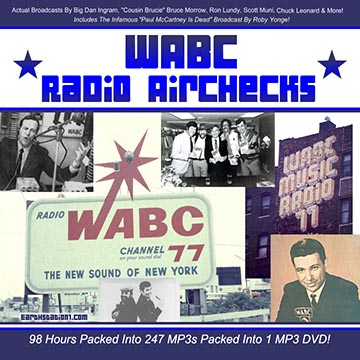
September 7, 1934: #BOTD: #HBD! Dan
Ingram, also known as Big Dan Ingram, American Top 40 radio disc
jockey with a fifty-year career on radio stations such as WABC and
WCBS-FM in New York, one of the most highly regarded disc jockeys
of his era and by a number of metrics the greatest radio DJ ever
(d. June 24, 2018) is #born Daniel Trombley Ingram in Oceanside,
New York. Dan Ingram started broadcasting at WHCH Hofstra College,
Hempstead, New York, WNRC, New Rochelle, New York, and WALK-FM,
Patchogue, New York. He was noted for his quick wit and ability to
convey a humorous or satiric idea with quick pacing and an economy
of words-a skill which made him uniquely suited to, and successful
within, personality-driven music radio of the ear. He is among the
most frequently emulated radio personalities, cited as an
influence or inspiration by numerous current broadcasters. One of
Ingram's unique skills was his ability to "talk up" to
the lyrics of a record, meaning speaking over the musical
introduction and finishing exactly at the point when the lyrics
started. Dan was well known for playing doctored versions of
popular songs. The Paul McCartney and Wings song My Love Does it
Good became My Glove Does it Good. The stuttering title refrain of
Bennie and the Jets went from three or four repetitions to
countless. In the same vein, the distinctive refrain added to
Hooked on a Feeling by Blue Swede, Ooga-chucka-ooga-ooga would
start repeating and listeners would never know when it would end.
(Other examples include Paul Simon's 50 Ways to Leave Your Lover
which he called "50 Ways to Love Your Leaver", and
"rearranging" the spelling of "S-A-T-U-R-D-A-Y"
on the Bay City Rollers' Saturday Night.) Dan's longtime closing
theme song was "Tri-Fi Drums" by Billy May. An edited
version of the song was used for broadcast. TV commercials Dan
narrated include a 1970 promo for free cut-out records of Archies
songs on the backs of Post Honeycomb and Alpha-Bits cereals. Dan
is not related to Clarke Ingram, another top 40 radio personality
in New York City who worked at Z-100 during the early 1990s.
Clarke has said that he was reluctant to use "Ingram"
(his real name) because of Dan's prominence, but that Z-100
encouraged him to do so because at the time Dan was not on the air
at any station. About six months later, Dan returned to the air,
doing weekends at WCBS-FM, and the two occasionally competed in
the same time slots. Some listeners mistakenly assumed that Clarke
was Dan's son, or another relative. (A photo of Dan and Clarke
meeting each other for the first time appeared in the radio trade
publication FMQB in 1997.) However, Dan's son, Chris, was a DJ at
WVOS-FM in Monticello, NY and most recently at WRMF in West Palm
Beach, Florida. Dan is also featured prominently in his son,
Chris' book, "Hey Kemosabe! The Days (and Nights) of a Radio
Idyll," a fictionalzed account of the Musicradio WABC era.
Dan commented occasionally about the pronunciation of his name:
jingles often are heard pronouncing his last name as "Ing-ram,"
but Dan has said it is correctly pronounced "In-gram."
As a tribute to Dan in later years, ESPN's Chris Berman would do
the same when saying the name of New York Giants wide receiver
Mark Ingram, pronouncing it "Marrrrrk In-gram". Dan was
interviewed about his career by Mark Simone on WABC Post-Rewound
show on May 29, 2006. While discussing a lawsuit filed against him
by another person who used his name, he said "shit".
While the dump button managed to erase that profanity from the
air, his second profanity ("fuck") accidentally went on
the air due to a delay problem. With his best friend, Ron Lundy,
he hosted "The Last Show", the last broadcast of WABC'
Top 40 MusicRadio format, before WABC' format conversion from
music to talk radio, at noon on May 10, 1982. Dan Ingram died in
Fort Lauderdale, Florida aged 83 of choking on a piece of steak
(one of his favorite foods). His burial details are not publicly
disclosed. On Sale Until Midnight Tonight PT!
https://store.earthstation1.com/wabc-musicradio-shows-mp3-dvd-60s80s-am-360807775.html
Today's
EarthStation1.com 15% (Or More!) Off Commemorative Memorial Title:
Pioneers Of Surgery Documentary TV Series DVD, MP4 Download, USB
Drive
Today, September 7, 2026
September 7, 1908: #BOTD: #HBD! Michael
DeBakey, Lebanese-American pioneer of surgery, vascular surgeon
and cardiac surgeon, scientist and medical educator (d. July 11,
2008) is #born Michel Dabaghi at Lake Charles, Louisiana to
Lebanese Maronite Christian immigrants. Michael Ellis DeBakey
became the chancellor emeritus of Baylor College of Medicine in
Houston, Texas, director of the Houston Methodist DeBakey Heart &
Vascular Center (formerly known as Methodist DeBakey Heart &
Vascular Center), and senior attending surgeon at Houston
Methodist Hospital (formerly known as the Methodist Hospital) in
Houston, with a career spanning 75 years. DeBakey was inspired to
pursue a career in medicine by the physicians that he had met at
his father's drug store, and he simultaneously learned sewing
skills from his mother. He subsequently attended Tulane University
for his premedical course and Tulane University School of Medicine
to study medicine. At Tulane, he developed a version of the roller
pump (peristaltic pump), which he initially used to transfuse
blood directly from person to person and which later became a
component of the heart-lung machine. Following early surgical
training at Charity Hospital, DeBakey was encouraged to complete
his surgical fellowships in Europe, before returning to Tulane
University in 1937. During the Second World War, he helped develop
the Mobile Army Surgical Hospital (MASH) units and later helped
establish the Veterans Administration Medical Center Research
System. DeBakey's research specialized in vascular and
cardiovascular surgery, and heart transplantation. DeBakey's
surgical innovations included coronary bypass operations, carotid
endarterectomy, artificial hearts and ventricular assist devices.
He used polyethylene terephthalate (Dacron) grafts to replace or
repair blood vessels and pioneered surgical repairs of aortic
aneurysms, an operation he himself underwent at the age of 97.
DeBakey received a number of awards, including the Presidential
Medal Of Freedom, the National Medal of Science, and the
Congressional Gold Medal. In addition, a number of institutions
bear his name. Michael DeBakey died at Houston Methodist in
Houston, two months before his 100th birthday; the cause of death
remained unspecified. After lying in repose in Houston's City
Hall, the first ever to do so, DeBakey received a memorial service
at the Co-Cathedral of the Sacred Heart on July 16, 2008. He was
granted ground burial at Arlington National Cemetery by the
Secretary of the Army. On Sale Until Midnight Tonight PT!
https://store.earthstation1.com/pioneers-of-surgery-dvd-set-4-episode-tv-series-2-dis42.html
Today's
EarthStation1.com 15% (Or More!) Off Commemorative Memorial Title:
Stalin: The Red Tsar TV Series + Soviet Assassins MP4 Download DVD
Set
Today, September 7, 2026
September 7, 1978: The Aftermath Of World
War II: The Cold War: The Cold War (1962-1979): The Cold War Era
Of Stagnation (1964-1982): Covert Operations: Eastern Bloc Covert
Operations: Assassinations: Covert Assassinations: Eastern Bloc
Covert Assassinations: The Bulgarian Umbrella: The Bulgarian
Umbrella Murder (The Umbrella Murder): -- While walking across
Waterloo Bridge in London spanning the River Thames, Bulgarian
dissident Georgi Markov waited to take a bus to his job at the
BBC. While at the bus stop, he felt a slight sharp pain, as a bug
bite or sting, on the back of his right thigh. He looked behind
him and saw a man picking up an umbrella off the ground. The man
hurriedly crossed to the other side of the street and got in a
taxi which then drove away. The event is now known as the
"Umbrella Murder", and is famous as one of the most
mysterious and most unusual of all covert political
assassinations. When Markov arrived at work at the BBC World
Service offices, he noticed a small red pimple had formed at the
site of the sting he had felt earlier and the pain had not
lessened or stopped. He told at least one of his colleagues at the
BBC about this incident. That evening he developed a fever and was
admitted to St James' Hospital in Balham, where he died four days
later, on September 11, 1978, at the age of 49. The cause of death
was poisoning from a ricin-filled pellet. Markov had in fact been
poisoned by Bulgarian secret police agent Francesco Giullino by
means of a micro-engineered ricin pellet fired into his leg by a
"Bulgarian Umbrella", an umbrella with a hidden
pneumatic mechanism designed to inject ricin pellets. The KGB
developed weapons using ricin which were known to have been used
outside the Soviet bloc, and they were they were the supplier of
the ricin that Bulgarian Umbrella device was designed to utilize.
Ten days before the murder, an attempt was made to kill another
Bulgarian defector, Vladimir Kostov, in the same manner as Markov,
in a Paris metro station. KGB defector Oleg Kalugin confirmed that
the KGB arranged the murder, even presenting the Bulgarian
assassin with alternatives such as a poisonous jelly to smear on
Markov's skin, but to date no one has been charged with Markov's
murder, largely because most documents relating to it are
unavailable, probably destroyed. Georgi Ivanov Markov (March 1,
1929 - September 11, 1978) was a Bulgarian dissident writer who
had been a novelist and playwright in his native country, the
People's Republic of Bulgaria, until his defection in 1968. After
relocating to London, he worked as a broadcaster and journalist
for the BBC World Service, the US-funded Radio Free Europe and
West Germany's Deutsche Welle. Markov used such forums to conduct
a campaign of sarcastic criticism against the incumbent Bulgarian
regime, which, according to his wife at the time he died,
eventually became "vitriolic" and included "really
smearing mud on the people in the inner circles". Markov's
grave is in a small churchyard at the Church of St Candida and
Holy Cross in Whitchurch Canonicorum, Dorset. Francesco Gullino
(or Giullino), born May 31 1945 in Bra, Piedmont, Italy is a Dane
of Italian origin who, according to Bulgarian journalist Hristo
Hristov, was an occasional smuggler arrested twice in Bulgaria and
given the choice of going to prison or becoming a secret agent for
Bulgaria in the West. Based in Copenhagen with a cover as an art
dealer, Gullino was supposedly active as a Bulgarian agent known
by the code name "Piccadilly" until 1990, and received
two Bulgarian state medals "for services to security and
public order". He was briefly detained in 1993 and questioned
by the British and Danish police in Copenhagen and, according to
Hristov, then dropped out of sight. He was named in June 2005 by
The Times, a British daily national newspaper based in London, as
the prime suspect in the murder. A British documentary, The
Umbrella Assassin (2006), interviewed people connected with the
case in Bulgaria, Britain and the United States, and revealed that
at the time of the documentary's production that Gullino was alive
and well. Ricin, produced in the seeds of the castor oil plant,
Ricinus communis, is a highly potent toxin. A dose of purified
ricin powder the size of a few grains of table salt can kill an
adult human. The median lethal dose (LD50) of ricin for mice is
around 22 micrograms per kilogram of body weight via
intraperitoneal injection. Oral exposure to ricin is far less
toxic. An estimated lethal oral dose in humans is approximately 1
milligram per kilogram. On Sale Until Midnight Tonight PT!
https://store.earthstation1.com/stalin-the-red-tsar-dvd-complete-4-part-tv-series-2-dis42.html
Today's
EarthStation1.com 15% (Or More!) Off Commemorative Memorial Title:
Franklin D. Roosevelt Documentaries DVD, Video Download, USB Drive
Today, September 7, 2026
September 7, 1900: #BOTD: Giuseppe
Zangara, Italian-American attempted assassin of US President-elect
Franklin D. Roosevelt, assassin of Anton Cermak (d. March 20,
1933) is #born in Ferruzzano, Calabria, Italy. During a night
speech by Roosevelt in Miami, Florida 17 days before his
inauguration as president, Zangara fired five shots at him with a
handgun he had purchased a couple of days before. He missed his
target, and instead injured five bystanders and killed Anton J.
Cermak, the Mayor of Chicago, who died of his wounds on March 6,
1933. Zangara confessed in the Dade County Courthouse jail,
stating: "I have the gun in my hand. I kill kings and
presidents first and next all capitalists." After spending
only 10 days on death row, Zangara died by execution in "Old
Sparky", the electric chair at Florida State Prison in
Raiford. Zangara became enraged when he learned no newsreel
cameras would be filming his final moments. Zangara's final
statement was "Viva l'Italia! Goodbye to all poor peoples
everywhere!... Push the button! Go ahead, push the button!".
He is buried at Florida State Prison Cemetery in Raiford, Union
County, Florida. While most accounts for years repeated that
Cermak was the unintended victim of an attempt to assassinate
Roosevelt, more recent theories, especially in Chicago, assert
that Zangara was a hired killer working for Frank Nitti, who was
the head of the Chicago Outfit (Chicago's largest organized crime
syndicate). John William Tuohy, author of numerous books on
organized crime in Chicago, after reviewing Secret Service
records, described in detail how and why Cermak was the real
target and the relationship of the shooting to the rampant gang
violence in Chicago. Numerous researchers, citing court testimony,
assert that Cermak had directed an assassination attempt on Nitti
fewer than three months earlier. Another point is that Zangara had
been an expert marksman in the Italian Army (though not with a
pistol from a great distance) and would presumably hit his target.
On Sale Until Midnight Tonight PT!
https://store.earthstation1.com/franklin-roosevelt-documentaries-dual-layer-dvd.html
Today's
EarthStation1.com 15% (Or More!) Off Commemorative Memorial Title:
The Temple In Jerusalem & The Ark Of The Covenant MP4 Download
DVD
Today, September 7, 2026
September 7, AD 70: Jerusalem: The
History Of Jerusalem: Religion: The History Of Religion: Abrahamic
Religions: Judaism: The History Of Judaism: The History Of Israel:
Judaea: The History Of Judaea: The Jewish-Roman Wars: The First
Jewish-Roman War (The Great Jewish Revolt (Hebrew: Ha-Mered
Ha-Gadol), The Jewish War): Sieges Of Jerusalem: The Siege Of
Jerusalem (70 CE) (Sieges Of Jerusalem: The Siege Of Jerusalem):
The Fall Of Herod's Palace: -- The Siege Of Jerusalem nears its
end as the Roman army under Titus, that had breached the walls of
Jerusalem on July 15 and destroyed Herod's Temple on August 30,
succeeds in causing The Fall Of Herod's Palace, and occupies and
plunders Jerusalem. The conquest of the city was complete the
following day, September 8. The Siege Of Jerusalem in the year 70
CE was the decisive event of the First Jewish-Roman War. The Roman
army, led by the future Emperor Titus, with Tiberius Julius
Alexander as his second-in-command, besieged and conquered the
city of Jerusalem, which had been controlled by Judean rebel
factions since 66 CE, following the Jerusalem riots of 66, when
the Judean Free Government was formed in Jerusalem. The siege
ended on August 30, 70 CE with the final burning and destruction
of what whas left of the Second Temple, and the Romans entered and
sacked the Lower City. The destruction of both the first and
second temples is still mourned annually as the Jewish fast Tisha
B'Av. The Arch of Titus, celebrating the Roman sack of Jerusalem
and the Temple, still stands in Rome. The conquest of the city was
complete on September 8, 70 CE. On Sale Until Midnight Tonight PT!
https://store.earthstation1.com/teinjearkofc.html
Today's
EarthStation1.com 15% (Or More!) Off Commemorative Memorial Title:
Forever James Dean Biography Documentary DVD, MP4 Download, USB
Drive
Today, September 7, 2026
September 7, 1909: #BOTD: #HBD! Elia
Kazan, Greek-American actor, film director, film producer and
screenwriter (d. September 28, 2003) is #born Elias Kazantzoglou
in the old Byzantine Contantinople Fener district of Istanbul, to
Cappadocian Greek parents originally from Kayseri in Anatolia,
Kazan was described by The New York Times as "one of the most
honored and influential directors in Broadway and Hollywood
history". After attending Williams College and then the Yale
School of Drama, he acted professionally for eight years, later
joining the Group Theatre in 1932, and co-founded the Actors
Studio in 1947. With Robert Lewis and Cheryl Crawford, his actors'
studio introduced "Method Acting" under the direction of
Lee Strasberg. Kazan acted in a few films, including City for
Conquest (1940). His films were concerned with personal or social
issues of special concern to him. Kazan writes, "I don't move
unless I have some empathy with the basic theme." His first
such "issue" film was Gentleman's Agreement (1947), with
Gregory Peck, which dealt with anti-Semitism in America. It
received eight Oscar nominations and three wins, including Kazan's
first for Best Director. It was followed by Pinky, one of the
first films in mainstream Hollywood to address racial prejudice
against African Americans. In 1954, he directed On the Waterfront,
a film about union corruption on the New York harbor waterfront. A
Streetcar Named Desire (1951), an adaptation of the stage play
which he had also directed, received twelve Oscar nominations,
winning four, and was Marlon Brando's breakthrough role. In 1955,
he directed John Steinbeck's East of Eden, which introduced James
Dean to movie audiences. A turning point in Kazan's career came
with his testimony as a witness before the House Committee on
Un-American Activities in 1952 at the time of the Hollywood
blacklist, which brought him strong negative reactions from many
liberal friends and colleagues. His testimony helped end the
careers of former acting colleagues Morris Carnovsky and Art
Smith, along with the work of playwright Clifford Odets. The two
men had made a pact to name each other in front of the committee.
Kazan later justified his act by saying he took "only the
more tolerable of two alternatives that were either way painful
and wrong." Nearly a half-century later, his anti-Communist
testimony continued to cause controversy. When Kazan was awarded
an honorary Oscar in 1999, dozens of actors chose not to applaud
as 250 demonstrators picketed the event. Kazan influenced the
films of the 1950s and 1960s with his provocative, issue-driven
subjects. Director Stanley Kubrick called him, "without
question, the best director we have in America, [and] capable of
performing miracles with the actors he uses." Film author Ian
Freer concludes that even "if his achievements are tainted by
political controversy, the debt Hollywood-and actors
everywhere-owes him is enormous." In 2010, Martin Scorsese
co-directed the documentary film A Letter to Elia as a personal
tribute to Kazan. Elia Kazan died of natural causes in his
Manhattan apartment, aged 94. He is buried at Greenwood Union
Cemetery in Rye, New York. On Sale Until Midnight Tonight PT!
https://store.earthstation1.com/james-dean-forever-1988-biography-documentary1988.html
Today's
EarthStation1.com 15% (Or More!) Off Commemorative Memorial Title:
Heart Of The Dragon TV Series DVD, Video Download, USB Flash Drive
Today, September 7, 2026
September 7, 1913: #BOTD: #HBD! Anthony
Quayle, English actor and theatre director (d. October 20, 1989)
is #born John Anthony Quayle in Ainsdale, Southport, Lancashire,
North West England to a Manx family (people originating in the
Isle of Man in the Irish Sea in northern Europe). Sir John Anthony
Quayle, CBE (Commander Of The Most Excellent Order Of The British
Empire) Kt (Knight Bachelor), was nominated for an Oscar and a
Golden Globe for his supporting role as Thomas Wolsey in the 1969
film Anne of the Thousand Days. He was educated at the private
Abberley Hall School and Rugby School and trained at the Royal
Academy of Dramatic Art in London. After appearing in music hall,
he joined the Old Vic in 1932. During World War II, he was a
British Army officer and was made one of the area commanders of
the Auxiliary Units in Northumberland. Later he joined the Special
Operations Executive and served as a liaison officer with the
partisans in Albania (reportedly, his service with the SOE
seriously affected him, and he never felt comfortable talking
about it). He described his experiences in a fictionalised form in
Eight Hours from England. He was an aide to the Governor of
Gibraltar at the time of the air crash of General Wladyslaw
Sikorski's aircraft on 4 July 1943. Sikorski became Prime Minister
of the Polish Government in Exile, Commander-in-Chief of the
Polish Armed Forces, and a vigorous advocate of the Polish cause
in the diplomatic sphere. He supported the reestablishment of
diplomatic relations between Poland and the Soviet Union, which
had been severed after the Soviet pact with Germany and the 1939
Invasion Of Poland-however, Soviet leader Joseph Stalin broke off
Soviet-Polish diplomatic relations in April 1943 following
Sikorski's request that the International Red Cross investigate
the Katyn Forest massacre. In July 1943, a plane carrying Sikorski
plunged into the sea immediately after takeoff from Gibraltar,
killing all on board except the pilot. The exact circumstances of
Sikorski's death have been disputed and have given rise to a
number of different theories surrounding the crash and his death.
Sikorski had been the most prestigious leader of the Polish
exiles, and his death was a severe setback for the Polish cause.
Quayel fictionalised his Gibraltar experience in his second novel
On Such a Night, published by Heinemann. From 1948 to 1956 Quayle
directed at the Shakespeare Memorial Theatre, and laid the
foundations for the creation of the Royal Shakespeare Company. His
own Shakespearian roles included Falstaff, Othello, Benedick in
Much Ado About Nothing, Henry VIII and Aaron in Titus Andronicus
opposite Laurence Olivier; he played Mosca in Ben Jonson's
Volpone; and he also appeared in contemporary plays. He played the
role of Moses in Christopher Fry's play The Firstborn, in a
production starring opposite Katharine Cornell. He also made an LP
with Cornell, in which he played the role of poet Robert Browning
in The Barretts of Wimpole Street. His first film role was a brief
uncredited one as an Italian wigmaker in the 1938 Pygmalion -
subsequent film roles included parts in Alfred Hitchcock's The
Wrong Man, Moscow Nights (I Stand Condemned), Michael Powell and
Emeric Pressburger's The Battle Of The River Plate (both 1956),
Ice Cold in Alex (1958), Tarzan's Greatest Adventure (1959), The
Guns of Navarone (1961), H.M.S. Defiant, David Lean's Lawrence of
Arabia (both 1962) and The Fall of the Roman Empire (1964). He was
nominated for an Academy Award for Best Supporting Actor in 1969
for his role as Cardinal Wolsey in Anne of the Thousand Days.
Often cast as the decent British officer, he drew upon his own
wartime experiences, bringing a degree of authenticity to the
parts notably absent from the performances of some non-combatant
stars. One of his best friends from his days at the Old Vic was
fellow actor Alec Guinness, who appeared in several films with
him. He was also a close friend of Jack Hawkins and Jack Gwillim;
all four actors appeared in Lawrence of Arabia. Quayle made his
Broadway debut in The Country Wife in 1936. Thirty-four years
later, he won critical acclaim for his starring role in the highly
successful Anthony Shaffer play Sleuth, which earned him a Drama
Desk Award. Television appearances include the Armchair Theatre
episode "The Scent of Fear" (1959) for ITV, the title
role in the 1969 ITC drama series Strange Report and as French
General Villers in the 1988 miniseries adaptation of The Bourne
Identity. He starred in the 1981 miniseries Masada as Rubrius
Gallius. Also he narrated the miniseries The Six Wives of Henry
VIII in 1970. In 1984 he founded Compass Theatre Company, that he
inaugurated with a tour of The Clandestine Marriage, directing and
playing the part of Lord Ogleby. This production had a run at the
Albery Theatre, London. With the same company he subsequently
toured with a number of other plays, including Saint Joan, Dandy
Dick and King Lear with himself in the title role. Quayle was
appointed a Commander of the Order of the British Empire (CBE) in
the 1952 Birthday Honours and knighted in the 1985 New Year
Honours for services to the Theatre. He was married twice. His
first wife was actress Hermione Hannen (1913-1983); his second
wife and widow was Dorothy Hyson (1914-1996), known as "Dot"
to family and friends. He and Dorothy had two daughters, Jenny and
Rosanna, and a son, Christopher. He died at his home in Chelsea,
London, England from liver cancer. His burial place is unknown. On
Sale Until Midnight Tonight PT!
https://store.earthstation1.com/heart-of-the-dragon-dvds-post-mao-china-all-12-tv-shows-3-di123.html
Today's
EarthStation1.com 15% (Or More!) Off Commemorative Memorial Title:
The Joey Bishop Show w/Regis Philbin Sammy Davis Jr DVD, Download,
USB
Today, September 7, 2026
September 7, 1923: #BOTD: #HBD! Peter
Lawford, English-American actor, producer, and socialite (d.
December 24, 1984) is #born Peter Sydney Ernest Aylen in London,
England. Peter Sydney Ernest Lawford lived in the United States
throughout his adult life. He was a member of the "Rat Pack"
and the brother-in-law of President John F. Kennedy, and the
senators Robert F. Kennedy and Edward Kennedy. From the 1940s to
the 1960s, he was a well-known celebrity and starred in a number
of highly acclaimed films. In later years, he was noted more for
his off-screen activities as a celebrity than for his acting; it
was said that he was "famous for being famous". Lawford
died at Cedars-Sinai Medical Center in Los Angeles on Christmas
Eve, aged 61, from cardiac arrest. He suffered from kidney failure
and liver failure after years of substance abuse. His body was
cremated, and his ashes were interred at Westwood Village Memorial
Park Cemetery. Owing to a dispute between his widow Patricia
Seaton Lawford and the cemetery, Lawford's ashes were removed from
the cemetery in 1988 and scattered into the Pacific Ocean off the
coast of California by her, who invited the National Enquirer
tabloid to photograph the event. For his contribution to the
television industry, Peter Lawford has a star on the Hollywood
Walk of Fame located at 6920 Hollywood Boulevard. A plaque bearing
Lawford's name was erected at Westwood Village Memorial Park. On
Sale Until Midnight Tonight PT!
https://store.earthstation1.com/joey-bishop-show-dvd-regis-philbin-sammy-davis-jr-peter-lawford.html
Today's
EarthStation1.com 15% (Or More!) Off Commemorative Memorial Title:
Apartheid Documentaries Collection DVD, Video Download, USB Drive
Today, September 7, 2026
September 7, 1986: South Africa: The
History Of South Africa: Segregation: Racial Segregation:
Apartheid (Racial Segregation In South Africa): -- Desmond Tutu
becomes the first black man to lead the Anglican Diocese of Cape
Town, South Africa. Desmond Mpilo Tutu OMSG (South Africa's Order
For Meritorious Service), CH (British Commonwealth's Order Of The
Companions Of Honour) GCStJ (British Royal Order Of Chivalry's
Grand Cross Of The Order Of Saint John) (born 7 October 1931),
Nobel Peace Prize laureate, is a South African Anglican cleric and
theologian known for his work as an anti-apartheid and human
rights activist. He was the Bishop of Johannesburg from 1985 to
1986 and then the Archbishop of Cape Town from 1986 to 1996, in
both cases being the first indigenous black African to hold the
position. Theologically, he sought to fuse ideas from black
theology with African theology; politically, he identifies as a
socialist. Tutu was born of mixed Xhosa and Motswana heritage to a
poor family in Klerksdorp, British Imperial South Africa. Entering
adulthood, he trained as a teacher and married Nomalizo Leah Tutu,
with whom he had several children. In 1960, he was ordained as an
Anglican priest and in 1962 moved to the United Kingdom to study
theology at King's College London. In 1966 he returned to southern
Africa, teaching at the Federal Theological Seminary and then the
University of Botswana, Lesotho and Swaziland. In 1972, he became
the Theological Education Fund's director for Africa, a position
based in London but necessitating regular tours of the African
continent. Back in southern Africa in 1975, he served first as
dean of St Mary's Cathedral in Johannesburg and then as Bishop of
Lesotho, taking an active role in opposition to South Africa's
apartheid system of racial segregation and white-minority rule.
From 1978 to 1985 he was general-secretary of the South African
Council of Churches, emerging as one of South Africa's most
prominent anti-apartheid activists. Although warning the National
Party government that apartheid would lead to racial violence, as
an activist he stressed non-violent protest and foreign economic
pressure to bring about change. In 1985 he became Bishop of
Johannesburg and in 1986 the Archbishop of Cape Town, the most
senior position in southern Africa's Anglican hierarchy. In this
position he emphasised a consensus-building model of leadership
and oversaw the introduction of women priests. Also in 1986, he
became president of the All Africa Conference of Churches,
resulting in further tours of the continent. After President F. W.
de Klerk released the anti-apartheid activist Nelson Mandela from
prison in 1990 and the pair led negotiations to dissolve
apartheid, Tutu assisted as a mediator between rival black
factions. After the 1994 general election resulted in a coalition
government headed by Mandela, the latter selected Tutu to chair
the Truth and Reconciliation Commission to investigate past human
rights abuses committed by both pro and anti-apartheid groups.
Since apartheid's fall, Tutu has campaigned for gay rights and
spoken out on a wide range of subjects, among them the
Israel-Palestine conflict, his opposition to the Iraq War, and his
criticism of South African Presidents Thabo Mbeki and Jacob Zuma.
In 2010, he retired from public life. Tutu polarised opinion as he
rose to notability in the 1970s. White conservatives who supported
apartheid despised him, while many white liberals regarded him as
too radical; many black radicals accused him of being too moderate
and focused on cultivating white goodwill, while Marxist-Leninists
criticised his anti-communist stance. He was widely popular among
the black majority, and was internationally praised for his
anti-apartheid activism, receiving a range of awards, including
the Nobel Peace Prize. He has also compiled several books of his
speeches and sermons. On Sale Until Midnight Tonight PT!
https://store.earthstation1.com/apartheid-documentaries-dvd-racial-segregation-in-south-africa.html
Today's
EarthStation1.com 15% (Or More!) Off Commemorative Memorial Title:
Mary, Queen of Scots Vanessa Redgrave Glenda Jackson MP4 Download
DVD
Today, September 7, 2026
September 7, 1571: The English Monarchy
(The Monarchy Of The Kingdom Of England): The Irish Monarchy (The
Monarchy Of The Kingdom Of Ireland): Elizabeth I: The Reign Of
Elizabeth I: Assassination Plots Against Elizabeth I: The Ridolfi
Plot: -- Thomas Howard, 4th Duke Of Norfolk, is arrested for his
role in the Ridolfi plot to assassinate Queen Elizabeth I Of
England and replace her with Mary, Queen Of Scots. The Ridolfi
plot was a Catholic plot in 1571 to overthrow Queen Elizabeth I of
England and replace her with Mary, Queen of Scots. The plot was
hatched and planned by Roberto Ridolfi, an international banker
who was able to travel between Brussels, Rome and Madrid to gather
support without attracting too much suspicion, who lived in London
at the time. Ridolfi had contacted the Duke to negotiate his
participation in the eponymous plot to free Mary, put her on the
English throne and thus restore Catholicism in England. Ridolfi, a
Catholic fervent who was also an agent of the Holy See, oversaw
financing of the Rising of the North and had been plotting to
overthrow Elizabeth since 1569, began preparing the Plot based on
the Bull Regnans in Excelsis issued by Pope Pius V in February
1570, which excommunicated Elizabeth and urged Catholics to do all
they could to depose her. The Spanish intelligence service was
going to participate. Howard had already come into contact with
Philip II of Spain regarding a proposed invasion of England with
troops commanded by the Fernando Alvarez de Toledo y Pimentel, 3rd
Duke of Alba, who was based in the Netherlands. During the
negotiations, Norfolk gave Ridolfi verbal assurances that he was a
Catholic, despite the fact that he had been educated as a
Protestant. After some hesitation, Howard placed himself at the
head of the conspirators; and in return for his services he asked
the Spanish King "to approve of my own marriage with the
Queen of Scots.". On August 29, 1571, Norfolk's secretaries
William Barker and Robert Higford entrusted to Thomas Browne, a
Shrewsbury drapers merchant, what was purported to be a bag of
silver coin for delivery to Laurence Bannister, one of Norfolk's
officials in the north of England. Browne grew suspicious of the
bag's weight, opened it, and discovered 600 pounds in gold from
the French ambassador, destined for Scotland on Mary's behalf, and
ciphered letters. Because he knew Norfolk was under suspicion,
Browne reported his find to Cecil. Higford and Barker were
interrogated, the letters were partly deciphered, and a search for
the cipher key at Howard House uncovered a ciphered letter from
Mary hidden under a doormat. Norfolk's servants were arrested and
interrogated, and confessions were extracted from them by threats
or application of torture. Sir Thomas Smith and Thomas Wilson were
sent to confront Norfolk, who claimed the money was for his own
private purposes. The deciphered letter, however, proved that he
was lying. Unaware of his servants' confessions or the survival of
letters which, contrary to his instructions, had not been burnt,
he denied the charges against him. Norfolk was imprisoned in the
Tower on 5 September. Laurence Bannister testified on favour of
Norfolk, clarifying that the Duke's brother, Henry, was the one
who really intended to marry the former Scottish queen. Norfolk
initially denied all charges against him, but later admitted a
degree of involvement in the transmission of money and
correspondence to Mary's Scottish supporters and her participation
in the Ridolfi plot. The evidence to prosecute Norfolk was now
much stronger than in 1569-70, as it was clear that he had been
involved in a conspiracy with support from the Papacy, Spain and
possibly France, to overthrow and assassinate Elizabeth. At his
trial on January 16, 1572, which lasted twelve hours, Norfolk
pleaded his innocence. However, the jury of peers unanimously
found him guilty of high treason, and he was sentenced to death.
After Norfolk had been sentenced, it was reasonable to suppose
that his execution would quickly follow. It was rumoured that he
was to be executed on 31 January, whereupon crowds flocked to the
Tower. Elizabeth, torn between the demands of justice on the one
hand and Norfolk's 'nearness of blood [and] ... his superiority of
honour' on the other, did not sign the warrant until 9 February,
and on the next day she countermanded her instructions. She did
the same thing a fortnight later, to the dismay of Cecil (now
ennobled as Lord Burghley) and the Privy Council. They insisted
that Parliament be assembled to debate the threat posed by Norfolk
and Mary, although Elizabethan parliaments normally met only every
three or four years and the previous parliament had been dissolved
only ten months earlier. The new parliament, the fourth of
Elizabeth's reign, assembled on 8 May 1572. Over the course of the
next three weeks Burghley and the Council used their spokesmen in
the House of Commons to press the case for executing Norfolk. On
21 May, Leicester remarked that he could 'see no likelihood' that
Norfolk would be executed. In late May, two Council members went
so far as to observe that by failing to execute the Duke, the
queen was demonstrating that she believed the guilty verdict to be
incorrect, which 'dishonoureth the nobles that have condemned
him'. The Queen continued to resist re-signing the order, until
her opinion suddenly changed when she encountered strong
parliamentary pressure calling for the executions of both Norfolk
and Mary. As Stephen Alford has observed, Norfolk's execution 'was
the political price Elizabeth had to pay to save the Scottish
Queen'. Even so, Elizabeth was determined that the decision to
execute the Duke should be seen to be hers rather than
Parliament's. On Saturday, 31 May, the Crown's spokesmen in the
Commons persuaded the lower house, with great difficulty, to
postpone petitioning the Queen to execute the Duke until the
following Monday (2 June), 'in hope to hear news before that
time'. The hint was well taken, as Norfolk finally went to the
block less than one hour before the Commons reassembled. During
his last days, Howard was visited by his former tutor Foxe, who
gave him for the purpose of consolation a version in Latin of his
Book of Martyrs. Norfolk bequeathed to Foxe an annuity of _20 per
year. The Duke also wrote to his mother's second husband, Thomas
Steyning, asking that she be sent to the quiet of the countryside.
Norfolk feared that if his mother was in London on the day of his
execution, she might suffer health problems from shock. At sunrise
on June 2, 1572, Norfolk was led to a specially erected scaffold
on Tower Hill, accompanied by Foxe and by Alexander Nowell, Dean
of St Paul's. He addressed the crowd assembled to witness the
execution. Despite admitting that he deserved to die, he declared
himself to be partly innocent, whereupon he was interrupted by an
official, who warned him that he should not try to clear himself,
having been 'tried as honourably as any nobleman hath ever been in
this land'. Urged to wind up quickly, as 'the hour is passed',
Norfolk ended his speech by denying that he was a Catholic, as was
commonly believed. After bidding a tearful farewell to Foxe and
Nowell, and forgiving the executioner, the Duke removed his
doublet and laid his head on the block. Howard said the final
prayer "Lord into your hands I commend my spirit", the
last words Jesus Christ said on the Cross before dying, according
to the Gospel of Saint Luke, and then, before a silent crowd,
which had been urged not to shout out to avoid 'frighting' his
soul, the Duke's head was severed with a single stroke. Howard was
between aged 34 or 36 at the time of his death. Norfolk was the
first nobleman to be executed during Elizabeth's reign, and was
the first since Henry Grey, Duke of Suffolk, the father of Lady
Jane Grey, was executed early in Mary I's reign. Equally striking
was that he was the premier nobleman of England, the Queen's
second cousin and a leading member of the Privy Council. Until
recently, he had also been much admired by Elizabeth and Burghley.
Indeed, in 1565 Cecil had described Norfolk as 'wise, just,
modest, careful' and, despite his youth - he was then aged 27 or
29 - 'a father and stay to this country'. In the immediate
aftermath of his execution, Elizabeth was reportedly 'somewhat
sad' at the Duke's death. Norfolk was buried in Chapel of St.
Peter ad Vincula, in the Tower of London. Norfolk's lands and
titles were forfeit, although much of his estate was later
restored to his sons. The dukedom was restored, four generations
later, to his great-great-grandson Thomas Howard. Mary narrowly
escaped execution on that occasion, but after being implicated in
several subsequent Catholic plots, she finally fell from grace and
was executed in February 1587. On Sale Until Midnight Tonight PT!
https://store.earthstation1.com/mary-queen-of-scots-vanessa-redgrave-glenda-jackson-mp4-download-dvd.html
Today's
EarthStation1.com 15% (Or More!) Off Commemorative Memorial Title:
Monarchy In The UK: British Royal History MP4 Video Download DVD
Set
Today, September 7, 2026
September 7, 1533: #BOTD: #HBD! Queen
Elizabeth I, Queen Of England and Ireland from November 17, 1558
until her death (d. March 24, 1603) is #born in the Palace of
Placentia. also known as Greenwich Palace. Elizabeth I was
sometimes called The Virgin Queen, Gloriana or Good Queen Bess.
Some have suggested that she was the mother of Edward de Vere,
17th Earl Of Oxford, who was a favorite in Elizabeth's court and
who those who subscribe to the Oxfordian theory of Shakespearean
authorship believe was the true identity of William Shakespeare.
Whether she was or was not his mother, history officially records
that Elizabeth was childless, and thereby was the last monarch of
the House of Tudor. She was the daughter of King Henry VIII and
Anne Boleyn. She ascended the throne in 1558 at age 25. During her
reign, Britain became a world power by defeating the Spanish
Armada. The Anglican Church was also fully established. Elizabeth
I died at Richmond Palace, Surrey, England between two and three
in the morning, aged 69. A few hours later, her first cousin twice
removed, James VI of Scotland, the son of Mary, Queen of Scots,
was proclaimed King Of England; this laid the foundation for the
Kingdom of Great Britain. She is buried in Westminster Abbey in
Westminster, Greater London, England. On Sale Until Midnight
Tonight PT!
https://store.earthstation1.com/monarchy-in-the-uk-british-royal-history-mp4-video-download-dvd-set.html
Today's
EarthStation1.com #OnThisDay Commemorative Memorial Title: DJ
Madness! 1950s-60s-70s Radio Shows DVD, MP3 Download, USB Drive
Today, September 7, 2026 September 7, 1934: #BOTD: #HBD! Little
Milton, African American blues singer and guitarist, best known
for his number-one R & B single "We're Gonna Make It"
(d. August 4, 2005) is #born James Milton Campbell Jr. in
Inverness, Mississippi. His other hits include "Baby, I Love
You", "Who's Cheating Who?", and "Grits Ain't
Groceries (All Around The World)". A native of the
Mississippi Delta, Milton began his recording career in 1953 at
Sun Records before relocating to St. Louis and co-founding Bobbin
Records in 1958. It wasn't until Milton signed to Checker Records
that he achieved success on the charts. Other labels Milton
recorded for include Meteor, Stax, Glades, Golden Ear, MCA, and
Malaco. Milton was inducted into the Blues Hall of Fame in 1988.
Little Milton died aged 70 in Memphis, Tennessee, from
complications following a stroke. He is buried at Palm Memorial
Park in Las Vegas, Nevada. He was posthumously honored with a
marker on the Mississippi Blues Trail in Inverness.
https://store.earthstation1.com/dj-radio-airchecks-mp3-dvd-1950s60s70s-dis319506070.html
September 7, 1934: #BOTD: #HBD! Little
Milton, African American blues singer and guitarist, best known
for his number-one R & B single "We're Gonna Make It"
(d. August 4, 2005) is #born James Milton Campbell Jr. in
Inverness, Mississippi. His other hits include "Baby, I Love
You", "Who's Cheating Who?", and "Grits Ain't
Groceries (All Around The World)". A native of the
Mississippi Delta, Milton began his recording career in 1953 at
Sun Records before relocating to St. Louis and co-founding Bobbin
Records in 1958. It wasn't until Milton signed to Checker Records
that he achieved success on the charts. Other labels Milton
recorded for include Meteor, Stax, Glades, Golden Ear, MCA, and
Malaco. Milton was inducted into the Blues Hall of Fame in 1988.
Little Milton died aged 70 in Memphis, Tennessee, from
complications following a stroke. He is buried at Palm Memorial
Park in Las Vegas, Nevada. He was posthumously honored with a
marker on the Mississippi Blues Trail in Inverness.
https://store.earthstation1.com/dj-radio-airchecks-mp3-dvd-1950s60s70s-dis319506070.html
Today's
EarthStation1.com #OnThisDay Commemorative Memorial Title: The Who
Live At Long Beach Arena 1971 MP3 CD Audio Download, USB Drive
Today, September 7, 2026September 7, 1978: #DOTD: #RIP: Keith
Moon, English drummer, songwriter, and producer, best known the
drummer for the rock band the Who, noted for his unique style and
his eccentric, often self-destructive behaviour, one of the
greatst rock drummers whose drumming continues to be praised by
critics and musicians (b. August 23, 1946) #dies of an overdose of
clomethiazole, a sedative prescribed him to alleviate his alcohol
withdrawal symptoms, after having been the guest of Paul and Linda
McCartney at the preview of Paul's film The Buddy Holly Story and
dining with them afterwards at Peppermint Park in Covent Garden,
West End, London, England. Moon and his partner, swedish model
Annette Walter-Lax, returned to their flat. There they watched the
film The Abominable Dr. Phibes, and Moon asked Walter-Lax to cook
him steak and eggs. When she objected, Moon replied, "If you
don't like it, you can fuck off!" These were his last words.
Moon then took some clomethiazole tablets. When Walter-Lax checked
on him the following afternoon, she discovered he was dead. Who
manager Bill Curbishley phoned the flat at around 5:00 p.m.
looking for Moon, and Dymond gave him the news. Curbishley told
Townshend, who informed the rest of the band. Entwistle was giving
an interview to two journalists when he was interrupted by a phone
call with the news of Moon's death. When asked about the band's
future plans, Entwistle burst into tears and quickly ended the
interview. Moon's death came shortly after the release of Who Are
You. On the album cover, he is straddling a chair to hide his
weight gain; the words "Not to be taken away" are on the
back of the chair. Police determined that there were 32
clomethiafzole pills in Moon's system. Six were digested,
sufficient to cause his death; the other 26 were undigested when
he died. Max Glatt, an authority on alcoholism, wrote in The
Sunday Times that Moon should never have been given the drug. Moon
was cremated on September 13, 1978 at Golders Green Crematorium in
London, England, and his ashes were scattered in its Gardens of
Remembrance. Keith Moon was posthumously inducted into the Modern
Drummer Hall of Fame in 1982, becoming only the second rock
drummer to be chosen, and in 2011, Moon was voted the
second-greatest drummer in history by a Rolling Stone readers'
poll. Keith Moon was born Keith John Moon at Central Middlesex
Hospital in northwest London, England. Moon grew up in Alperton, a
suburb of Wembley, in Middlesex, and took up the drums during the
early 1960s. After playing with a local band, the Beachcombers, he
joined the Who in 1964 before they recorded their first single.
Moon remained with the band during their rise to fame, and was
quickly recognised for his drumming style, which emphasised
tom-toms, cymbal crashes, and drum fills. Throughout Moon's tenure
with the Who his drum kit steadily grew in size, and along with
Ginger Baker, Moon has been credited as one of the earliest rock
drummers to regularly employ double bass drums in his setup. He
occasionally collaborated with other musicians and later appeared
in films, but considered playing in the Who his primary occupation
and remained a member of the band until his death. In addition to
his talent as a drummer, however, Moon developed a reputation for
smashing his kit on stage and destroying hotel rooms on tour. He
was fascinated by blowing up toilets with cherry bombs or
dynamite, and by destroying television sets. Moon enjoyed touring
and socialising, and became bored and restless when the Who were
inactive. His 21st birthday party in Flint, Michigan, has been
cited as a notorious example of decadent behaviour by rock groups.
Moon suffered a number of setbacks during the 1970s, most notably
the accidental death of chauffeur Neil Boland and the breakdown of
his marriage. He became addicted to alcohol, particularly brandy
and champagne, and acquired a reputation for decadence and dark
humour; his nickname was "Moon the Loon." After moving
to Los Angeles with personal assistant Peter "Dougal"
Butler during the mid-1970s, Moon recorded his only solo album,
the poorly received Two Sides of the Moon. While touring with the
Who, on several occasions he passed out on stage and was
hospitalised. By their final tour with him in 1976, and
particularly during production of The Kids Are Alright and Who Are
You, the drummer's deterioration was evident. Moon moved back to
London in 1978, dying in September of that year from an overdose
of Heminevrin, a drug intended to treat or prevent symptoms of
alcohol withdrawal.
https://store.earthstation1.com/the-who-live-at-long-beach-arena-1971-m19713.html
Today's
EarthStation1.com #OnThisDay Commemorative Memorial Title:
Columbia Revolt: University Protests Of 1968 DVD, Download, USB
Drive
Today, September 7, 2026September 7, 2021: #DOTD: #RIP: Phil
Schaap, American jazz disc jockey, historian, archivist and
producer, proprietor of the Phil Schaap Jazz Shop (b. April 6,
1951) #dies at a hospital in Manhattan aged 70, having suffered
from lymphoma prior to his death. His burial details are not
publicly available. Phil Schaap was born Philip van Noorden Schaap
in the borough of Queens, New York, the most linguistically and
ethnically diverse place on Earth; the name of neigborhood in
Queens he was born in appears to have been assiduously avoided in
online biographies about him. Despite this, he is known to have
been raised in the Hollis neighborhood of Queens. An only child,
he was raised a self-described "jerky kid" by
jazz-loving parents; his father was Walter Schaap, a Jewish early
jazz historian and discographer and intimate of many jazz greats,
and his mother, Marjorie Wood Schaap, a Christian librarian and
classically trained pianist who at Radcliffe listened to Louis
Armstrong records and smoked a corncob pipe. He grew up surrounded
by jazz greats; Count Basie was known to have given him a joy ride
in his car, and he was babysat by the famed saxophonist Lester
Young and the famed drummer Jo Jones. Schaap attended Columbia
University as a history major. While in college, Schaap worked as
a sound engineer for the Grateful Dead on a number of occasions,
including during the 1968 Columbia University Protests. He hosted
jazz shows on Columbia University's FM radio station WKCR from
1970 until his death; he continues to hosts two shows in reruns:
Bird Flight and Traditions In Swing, both since 1981.
https://store.earthstation1.com/columbia-revolt-1969-dvd-university-student-upri1969.html
Today's
EarthStation1.com #OnThisDay Commemorative Memorial Title: 633
Squadron (1964) WWII Aviation Drama DVD, MP4 Download, USB Drive
Today, September 7, 2026September 7, 1994: #DOTD: #RIP: James
Clavell, Australian-born British (later naturalized American)
writer, screenwriter, director, producer, World War II veteran of
the Asia-Pacific War and prisoner of war held by the Japanese at
Changi Prison in Singapore (b. October 10, 1921) #dies in Vevey,
Switzerland of a stroke while suffering from cancer, aged 72. His
burial details are not publicly disclosed. After sponsorship by
his widow, the library and archive of the Royal Artillery Museum
at the Royal Arsenal, Woolwich, in southeast London, was renamed
the James Clavell Library in his honour. The library was later
closed pending the opening of a new facility in Salisbury,
Wiltshire; however, James Clavell Square on the Royal Arsenal
development on Woolwich riverside remains. James Clavell was born
Charles Edmund Dumaresq Clavell in Sydney, Australia. Clavell is
best known as the author of his Asian Saga novels, a number of
which have had television adaptations. Clavell also wrote such
screenplays as those for The Fly (1958) (based on the short story
by George Langelaan), The Great Escape (1963) (based on the
personal account of Paul Brickhill), and 633 Squadron (1964)
(based on the 1956 novel of the same name by former Royal Air
Force officer Frederick E. Smith, which itself drew on several
real RAF operations). He wrote and directed the popular 1967 film
To Sir, With Love. James Clavell wrote what became known as The
Asian Saga, a series of six novels written by between 1962 and
1993: King Rat (1962), Tai-Pan (1966), Shogun (1975), Noble House
(1981), Whirlwind (1986), and Gai-Jin (1993). The novels all
centre on Europeans in Asia, and together explore the impact on
East and West of the meeting of these two distinct civilizations.
Having joined The Royal Artillery in 1940 after the outbreak of
World War II in Europe, he was sent to Singapore to fight the
Japanese after the Attack On Pearl Harbor in December 1941. The
ship taking his unit was sunk en route to Singapore, and the
survivors were picked up by a Dutch boat fleeing to India. The
commander, described by Clavell years later as a "total
twit", insisted that they be dropped off at the nearest port
to fight the war despite having no weapons. Shot in the face, he
was captured in Java in 1942 and sent to a Japanese prisoner of
war camp on Java. Later he was transferred to Changi Prison in
Singapore. In 1981, Clavell recounted: "Changi became my
university instead of my prison. Among the inmates there were
experts in all walks of life-the high and the low roads. I studied
and absorbed everything I could from physics to counterfeiting,
but most of all I learned the art of surviving, the most important
course of all." Prisoners were fed a quarter of a pound of
rice per day, one egg per week and occasional vegetables. Clavell
believed that if atomic bombs had not been dropped on Hiroshima
and Nagasaki he would not have survived the war. Clavell did not
talk about his wartime experiences with anyone, even his wife, for
15 years after the war. For a time he carried a can of sardines in
his pocket at all times and fought an urge to forage for food in
trash cans. He also experienced bad dreams and a nervous stomach
kept him awake at night.
https://store.earthstation1.com/633-squadron-dvd-1964-raf-wwii-mosquito-aircraf6331964.html
Today's
EarthStation1.com #OnThisDay Commemorative Memorial Title: Vietnam
War Films & Documentaries Collection DVD, Download, USB Drive
Today, September 7, 2026September 7, 1965: The Aftermath Of World
War II: The Cold War: The Cold War In Asia: The Indochina Wars:
The Vietnam War (The Second Indochina War, The Vietnam Conflict,
The Resistance War Against America): The United States In The
Vietnam War: The Escalation Of The Vietnam War: Operation Piranha:
-- In a follow-up to August's Operation Starlight, the first major
offensive action by a purely U.S. military unit during the Vietnam
War, which was conducted from August 18-24, 1965, United States
Marines and South Vietnamese forces initiate Operation Piranha on
the Batangan Peninsula. Following the conclusion of Operation
Starlite, on August 24, 1965, Marine intelligence concluded that
the 1st VC Regiment had withdrawn into the Batangan Peninsula.
Reconnaissance photos of the Peninsula showed a V of older field
fortifications pointing inland with the open end to the sea and a
new second V further inland under construction. The plan of
operations was for a Battalion Landing Team (BLT) of the 1st
Battalion, 7th Marines to land across White Beach north of the
Peninsula and push south, while 3rd Battalion, 7th Marines, would
be helilifted in by MAG-16 to set up blocking positions 4 km
inland. 3rd Battalion, 3rd Marines would remain available as a
floating reserve. The Army of the Republic of Vietnam (ARVN) 2nd
Battalion, 4th Regiment and the 3rd Vietnamese Marine Battalion
would be helilifted into the south of 3/7 Marines to clear and
search the An Ky Peninsula. The operation was launched on 7
September 1965, the amphibious landing was unopposed, while the
landing of the ARVN force received some minor ground fire. On 8
September, Company B 1/7 Marines discovered a VC field hospital in
a large cave near the center of the Peninsula. The Marines
captured four prisoners, but then came under fire from other VC in
the cave. The Marines returned the fire and attempted to convince
the VC to surrender. Marine engineers then placed explosives in
the cave. After the detonation, the Marines counted 66 VC dead
inside. Operation Piranha concluded on 10 September, the US
claimed that 178 VC had been killed and 360 VC and suspected VC
had been captured. Allied losses were two Marines and five South
Vietnamese killed. The operation failed to wipe out the 1st VC
Regiment, villagers told the Marines that Vietcong units had been
in the area but had left, some less than 24 hours before Operation
Piranha had commenced. Intelligence reports later indicated that
the 1st VC Regiment began leaving the peninsula on 4 September,
coinciding with the increased movement of the amphibious ships at
Chu Lai Base Area.
https://store.earthstation1.com/vietnam-war-films-2-dual-layer--dvd-se2.html
Today's
EarthStation1.com #OnThisDay Commemorative Memorial Title: The
Hardly Worthit Report Faux Huntley-Brinkley MP3 CD, Download, USB
Today, September 7, 2026September 7, 1969: #DOTD: #RIP: Everett
Dirksen, American liberal republican politician, representative
and senator from Illinois, Senate Minority Leader from 1959 until
his death in 1969 who played a highly visible and key role in the
politics of the 1960s (b. January 4, 1896) #dies while still
serving as Senate Minority Leader of cardiopulmonary arrest after
lung cancer surgery caused bronchopneumonia at Walter Reed Army
Hospital, aged 73. Dirksen lay in state at the United States
Capitol rotunda, followed by burial at Glendale Memorial Gardens
in his hometown of Pekin, Illinois. The Dirksen Senate Office
Building is named after him. Everett Dirksen was born Everett
McKinley Dirksen in Pekin, Illinois, a small city near Peoria. He
helped write and pass the Civil Rights Act Of 1964 and the Civil
Rights Act Of 1968, both landmark pieces of legislation during the
civil rights movement. He was also one of the Senate's strongest
supporters of the Vietnam War. A talented orator with a florid
style and a notably rich baritone voice, he delivered flamboyant
speeches that caused his detractors to refer to him as "The
Wizard of Ooze". Dirksen served as an artillery officer
during World War I and opened a bakery after the war. After
serving on the Pekin City Council, he won election to the House of
Representatives in 1932. In the House, he was considered a
moderate and supported much of the New Deal; he became more
conservative and isolationist over time, but reversed himself to
support US involvement in World War II. He won election to the
Senate in 1950, unseating Senate Majority Leader Scott W. Lucas.
In the Senate, he favored conservative economic policies and
supported the internationalism of President Dwight D. Eisenhower.
Dirksen succeeded William F. Knowland as Senate Minority Leader
after the latter declined to seek re-election in 1958. As the
Senate Minority Leader, Dirksen emerged as a prominent national
figure of the Republican Party during the 1960s. He developed a
good working relationship with Senate Majority Leader Mike
Mansfield and supported President Lyndon B. Johnson's handling of
the Vietnam War. He helped break the Southern filibuster of the
Civil Rights Act Of 1964.
https://store.earthstation1.com/the-hardly-worthit-report-comedy-lp-mp3-cd-1966-huntleybri31966.html
Today's
EarthStation1.com #OnThisDay Commemorative Memorial Title: Desert
Storm: The Victory + Bonus Persian Gulf War I MP4 Download DVD
Today, September 7, 2026September 7, 2022: #DOTD: #RIP: Bernard
Shaw, African American journalist most famous as former lead news
presenter for CNN from 1980 until his retirement in March 2001 (b.
May 22, 1940) #dies at a hospital in Washington, D.C. at the age
of 82, after contracting pneumonia that was not related to
COVID-19 current at that time. As of 2024, his burial details are
not publicly disclosed. "When viewers watched Bernie, they
saw first and foremost, a journalist they could trust," said
CNN's Wolf Blitzer during CNN's memorial service for Bernard Shaw
at the National Press Club. Bernard Shaw was born in Chicago,
Illinois. He attended the University of Illinois at Chicago from
1963 to 1968. He served in the U.S. Marine Corps, including stints
in Hawaii and at Marine Corps Air Station, Cherry Point, North
Carolina, where in 1962 he was a "Message Center"
specialist, achieving the rank of Corporal, E-4. He exhibited a
passionate interest in the print media, clipping articles from
newspapers, and often traveled on weekends to Washington, D.C. He
cultivated an acquaintance with Walter Cronkite and had an
interest in baseball. Shaw began his broadcasting career as an
anchor and reporter for WNUS in Chicago. He then worked as a
reporter for the Westinghouse Broadcasting Company in Chicago,
moving later to Washington as the White House correspondent. He
worked as a correspondent in the Washington Bureau of CBS News
from 1971 to 1977. In 1977, he moved to ABC News as Latin American
correspondent and bureau chief before becoming the Capitol Hill
Senior Correspondent. He left ABC in 1980 to move to CNN as
co-anchor of its PrimeNews broadcast, anchoring from Washington,
D.C.. Shaw's coverage of the 1981 assassination attempt on U.S.
president Ronald Reagan (with Shaw joined by former CBS News
correspondent Daniel Schorr, one of the first on-air personalities
hired by the fledgling cable channel) is credited as helping to
establish CNN as a credible and reliable broadcast news source at
an early point in the network's history. Shaw is widely known for
the question he posed to Democratic U.S. presidential candidate
Michael Dukakis at his second Presidential debate with George H.
W. Bush during the 1988 election, which Shaw was moderating.
Knowing that Dukakis opposed the death penalty, Shaw asked him if
he would support an irrevocable death penalty for a man who
hypothetically raped and murdered Dukakis's wife. Dukakis
responded that he would not; critics felt he framed his response
too legalistically and logically, and did not address it
sufficiently on a personal level. Kitty Dukakis, among other
public figures, found the question inflammatory and unwarranted at
a presidential debate. Several journalists also on the panel with
Shaw, including Ann Compton, Andrea Mitchell, and Margaret Garrard
Warner, expressed an interest in leaving Dukakis's name out of the
question. He is also remembered for his reporting on the 1991 Gulf
War. Reporting with CNN correspondents John Holliman and Peter
Arnett from the Al-Rashid Hotel in Baghdad, he found shelter under
a desk as he reported cruise missiles flying past his window. He
also made frequent trips back and forth from the hotel's bomb
shelter. While describing the situation in Baghdad, he famously
stated "Clearly I've never been there, but this feels like
we're in the center of hell." He moderated the October 2000
vice-presidential debate between Dick Cheney and Joe Lieberman.
Shaw co-anchored CNN's Inside Politics from 1992 until he retired
from CNN in 2001. He has still occasionally appeared on CNN,
including in May 2005 when a plane flew into restricted air space
in Washington, D.C. He also co-anchored Judy Woodruff's last
broadcast on CNN in June 2005. Shaw noted that after 41 years in
the business, given what he missed in his personal life, the cost
was not worth it. Shaw appeared on the June 1, 2020 episode of
CNN's Erin Burnett OutFront to recognize the 40th anniversary of
the start of the network.
https://store.earthstation1.com/desert-storm-the-victory-persian-gulf-war-i-dvd-mp4-download-us4.html
Today's
EarthStation1.com #OnThisDay Commemorative Memorial Title: WWI: A
History In Pictures World War I JPG Photos CD, Download, USB
Today, September 7, 2026September 7, 1907: Maiden Voyages:
Watercraft: Merchant Ships (Merchant Vessels, Trading Vessels,
Merchantmen): Passenger Ships: Ocean Liners: RMS Lusitania: -- The
Cunard Line's RMS Lusitania sets sail on her maiden voyage from
Liverpool, England, to New York City. On May 7, 1915, the German
submarine U-20 sank her when she was torpedoed off the coast of
Ireland, losing 1,198 of its 1,924 passengers, including 128
Americans. The sinking turned public opinion in many countries
against Germany, contributed to the American entry into World War
I and became an iconic symbol in military recruiting campaigns of
why the war was being fought. The sinking of the Cunard Line ocean
liner RMS Lusitania occurred on Friday, 7 May 1915 during the
First World War, as Germany waged submarine warfare against the
United Kingdom which had implemented a naval blockade of Germany.
The ship was identified and torpedoed by the German U-boat U-20
and sank in 18 minutes. The vessel went down 11 miles (18 km) off
the Old Head of Kinsale, leaving 761 survivors. Lusitania fell
victim to torpedo attack relatively early in the First World War,
before tactics for evading submarines were properly implemented or
understood. The contemporary investigations in both the United
Kingdom and the United States into the precise causes of the
ship's loss were obstructed by the needs of wartime secrecy and a
propaganda campaign to ensure all blame fell upon Germany.
Argument over whether the ship was a legitimate military target
raged back and forth throughout the war as both sides made
misleading claims about the ship. At the time she was sunk, she
was carrying over 4 million rounds of small-arms ammunition (.303
caliber), almost 5,000 shrapnel shell casings (for a total of some
50 tons), and 3,240 brass percussion fuses, in addition to 1,266
passengers and a crew of 696. Several attempts have been made over
the years since the sinking to dive to the wreck seeking
information about precisely how the ship sank, and argument
continues to the present day.
https://store.earthstation1.com/wwi-a-history-in-pictures-world-war-i-photo-cd.html
Today's
EarthStation1.com #OnThisDay Commemorative Memorial Title: Future
Wars: Then And Now - Foreseen Warcraft Today MP4 Download DVD
Today, September 7, 2026September 7, 1997: Aviation: The History
Of Aviation: The History Of Military Aviation: Maiden Flights: --
The first Lockheed Martin F-22 Raptor, tail number 4001, is
unveiled at Dobbins Air Reserve Base in Marietta, Georgia, and
makes its first flight. The Lockheed Martin F-22 Raptor is an
American single-seat, twin-engine, supersonic all-weather stealth
fighter aircraft developed for the United States Air Force (USAF).
As a product of the USAF's Advanced Tactical Fighter (ATF) program
the aircraft was designed as an air superiority fighter, but also
incorporates ground attack, electronic warfare, and signals
intelligence capabilities. The prime contractor, Lockheed Martin,
built most of the F-22's airframe and weapons systems and
conducted final assembly, while Boeing provided the wings, aft
fuselage, avionics integration, and training systems. The aircraft
first flew in 1997 and was variously designated F-22 and F/A-22
before it formally entered service in December 2005 as the F-22A.
Although the USAF had originally planned to buy a total of 750
ATFs, the program was cut to 187 production aircraft in 2009 due
to high costs, a lack of air-to-air missions at the time of
production, and the development of the more affordable and
versatile F-35. The last F-22 was delivered in 2012. While it had
a protracted development and initial operational difficulties, the
F-22 has become a critical component of the USAF's tactical
airpower. The fighter's combination of stealth, aerodynamic
performance, and mission systems enabled a leap in air combat
capabilities and set the benchmark for its generation.
https://store.earthstation1.com/future-wars-then-and-now--foreseen-warcraft-today-mp4-download-dv4.html
Today's
EarthStation1.com #OnThisDay Commemorative Memorial Title: UFO
MP3s Collection: Alien Phenomena CD, MP3 Download, USB Drive
Today, September 7, 2026September 7, 2010: #DOTD: #RIP: Wendelle
Stevens, veteran US UFO researcher, specialising in contactee
research (b. January 18, 1923) #dies at his home in Tucson,
Arizona, aged 87. He is buried at Southern Arizona Veterans
Memorial Cemetery in Sierra Vista, Arizona. Lt. Col Wendelle C.
Stevens was born in Round Prairie, Minnesota. Stevens enlisted in
the U.S. Military Service at an early age. He alternated his
career between pilot and Air Technical Service assignments with
the Air Technical Intelligence Center (ATIC) at Wright Field. In
1947 Stevens was assigned from ATIC to Alaska where he first
encountered stories of real UFOs, and became interested in the
subject. Mr. Stevens had one of the largest collections of actual
UFO photographs in private hands in the world. He has been
actively investigating UFO contact cases since 1975 when his photo
interests brought him into investigating the famous Billy Meier
contactee case in Switzerland.
https://store.earthstation1.com/ufo-mp3s-tv-radio-and-audio-recordings-mp3-33.html
Today's
EarthStation1.com #OnThisDay Commemorative Memorial Title: The
Historical View A Legacy In Pictures JPG Image Set CD Download USB
Today, September 7, 2026September 7, 1906: Aviation: The History
Of Aviation: Aviation In The Pioneer Era: Alberto Santos-Dumont:
Maiden Flights: The Santos-Dumont 14-Bis (French: Quatorze-Bis;
Portuguese: Quatorze-Bis; English: Fourteen-Again) (Oiseau De
Proie [French, "Bird Of Prey"]): -- Alberto
Santos-Dumont, Brazilian Aviation Pioner, successfully flies for
the first time his experimental 14-Bis aircraft, a pioneer era
canard biplane he designed and built, at Bagatelle, France. The
14-Bis made a series a flights near Paris in between September and
November 1906 that were the first manned powered flights to be
publicly witnessed by a crowd, and the first by an airplane
outside the U.S. This experiement early aircraft was only able to
fly in short hops for a matter of seconds, and was not a reliable
flying machine; by comparison, on October 5, 1905, Wilbur Wright
made a circling flight of 38.9 km (24 mi) in 39 minutes 23
seconds, a year before Santos-Dumont flew the 14-Bis 50 m (160 ft)
flight to earn him his first aviation award.
https://store.earthstation1.com/the-historical-view-a-legacy-in-pictures-jpg-photo-cd.html
Today's
EarthStation1.com #OnThisDay Commemorative Memorial Title:
Frontiers Of Flight Aviation History TV Series DVD, MP4, USB Drive
Today, September 7, 2026September 7, 1909: #DOTD: #RIP: Eugene
Lefebvre, French aviation pioneer believed to be the first stunt
pilot (b. October 4, 1878) #dies as he becomes the first aviator
to die piloting an airplane, and the second person to be killed in
a powered airplane crash, when he crashes a new French-built
Wright biplane during a test flight at Juvisy, south of Paris. As
the chief pilot for the French Wright Company, Lefebvre was a
participant in the first international air race, the Grande
Semaine d'Aviation at Reims in 1909, piloting a Wright Flyer. His
burial details, as well as his birth place, are not publicly
known. He, Louis Bleriot and Hubert Latham were selected as
France's representatives during the contest for the Gordon Bennett
Trophy on August 22, after poor weather made the morning's planned
qualifying run impossible. When the weather lifted around 6
o'clock that evening, Lefebvre was one of the pilots who took to
the sky in an exhibition, giving one of the earliest displays of
stunt flying. The New York Times described his maneuvers thus:
"Lefebvre... came driving at the crowded tribunes, turned in
the nick of time, went sailing off, swooped down again till he
made the flags on the pillars and the plumes on the ladies' hats
flutter, and so played about at will for our applause." He
was subsequently fined 4 USD by the judges for displaying
excessive "recklessness and daring." During the running
of the race, he placed fourth, behind Glenn Curtiss, Bleriot and
Latham. Only nine days after the end of the Reims event, Lefebvre
was killed when the plane he was testing dropped to the ground
from a height of 6 metres (20 ft). Lefebvre is a distant relative
of the later film actress Capucine (1928-1990).
https://store.earthstation1.com/frontiers-of-flight-aviation-history-tv-series-dvd-mp4-download-us4.html